You may have heard that a Phoenix shingle roof runs 160 to 170°F on a July afternoon. That raises two fair questions. What does that kind of heat do to the roof? And does it change which treatment, if any, should go on it?
This page answers both, with a source linked for every number. Where the published data stops, we say so. It stops sooner than most people expect, and that matters for any roof treatment sold in the desert, including the one we use.
The Phoenix heat numbers
| Measure | Number | Source |
|---|---|---|
| Average July high at Sky Harbor, 1991 to 2020 | 106.5°F | NOAA climate normals |
| Average July low, same station and period | 84.5°F | NOAA climate normals |
| Days a year at 100°F or hotter, 1991 to 2020 average | 111 | NWS Phoenix |
| Days a year at 110°F or hotter, 1991 to 2020 average | 21 | NWS Phoenix |
| Most 110°F days in a single year | 70, set in 2024 | NWS Phoenix |
| Average first and last 100°F day, 1991 to 2020 | May 2 and Oct 5 | NWS Phoenix |
| Typical summer midday UV index in Phoenix | 10, rated Very High | EPA UV Index guide |
| Midday summer peak for a standard black asphalt roof (national, not Phoenix-measured) | 165 to 185°F | U.S. EPA |
| Rain in an average year | 7.22 inches | NOAA climate normals |
Two things stand out. The hot season is long: on average the first 100°F day comes in early May and the last one in early October. And the nights don’t give a roof much of a break, with an average July low of 84.5°F. The National Weather Service also called 2024 “the warmest year recorded in the history of Phoenix”.
How hot the roof itself gets
Air temperature is not roof temperature. A dark roof in full sun runs far hotter than the air around it. In a peer-reviewed review of how roofing materials weather, Lawrence Berkeley National Laboratory researchers put a black roof in full sunlight at about 61 to 90°F above the surrounding air (Berdahl and others, 2008).
The U.S. EPA says “standard black asphalt roofs can reach 165 to 185°F (74 - 85°C) at midday during the summer.” That is a national figure. It was not measured in Phoenix.
So is 160 to 170°F a fair number for a Phoenix shingle roof? It sits inside the range those national sources describe. Color matters too. The inspectors’ association InterNACHI notes that “darker roofs absorb more heat”.
What we could not find is a published, measured shingle temperature for Phoenix. So we don’t state one as fact. We use the EPA range and say where it comes from.
What heat and sun do to asphalt
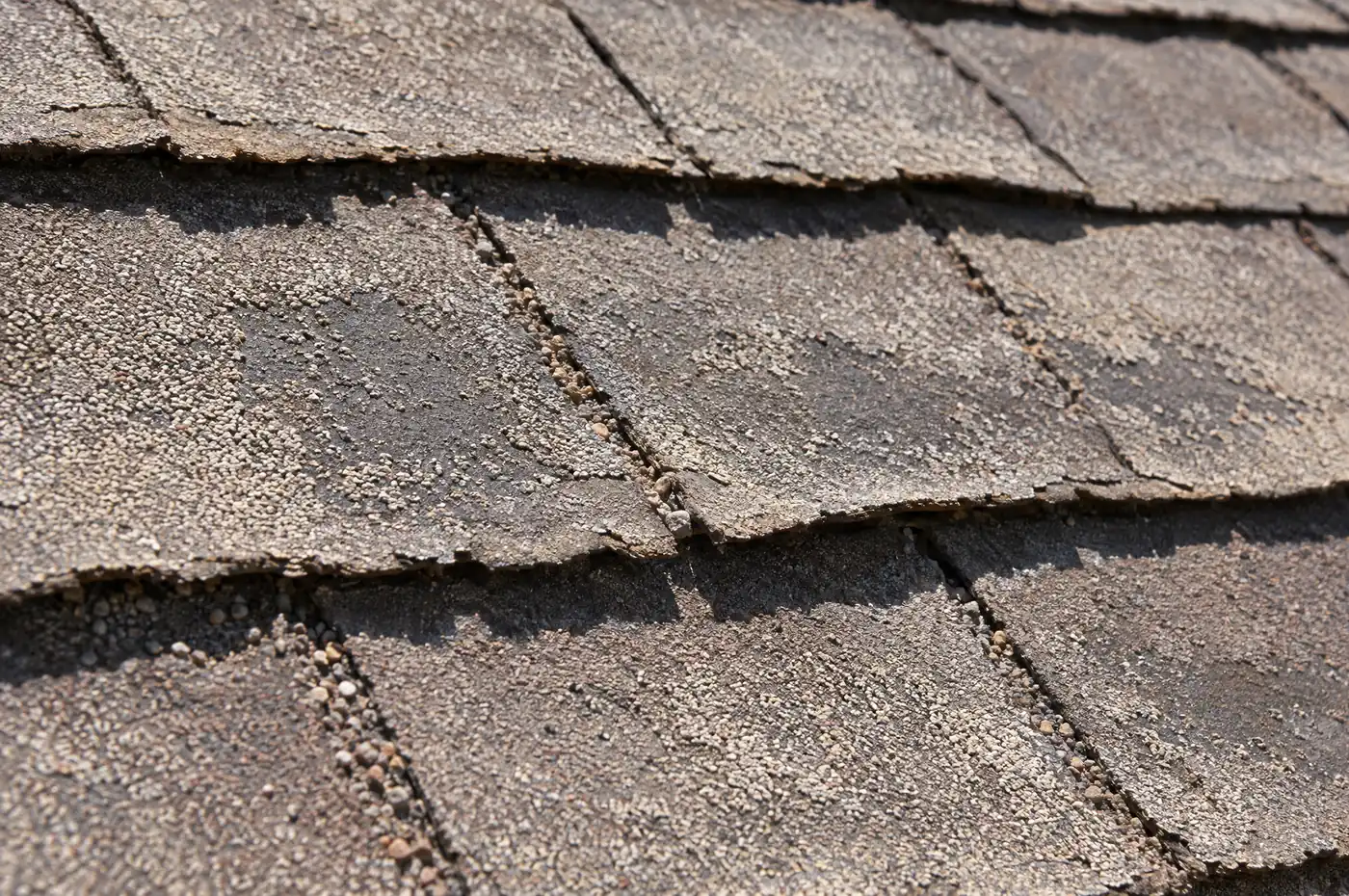
Oxidation hardens the asphalt
Asphalt is the glue and the waterproofing in a shingle. Oxygen slowly reacts with it. The LBNL review says that “as a result of oxidation, asphalt becomes harder and embrittled.” Heat speeds the process up. The same paper says higher temperature “can accelerate deleterious chemical reactions, cause loss of volatile constituents, and soften some polymers.”
The lighter oils move out
Fresh asphalt holds lighter oils that keep it flexible. The LBNL paper describes a model where “heat first promotes the diffusion of (lower molecular weight) oils out of the bulk of the asphalt. Then, some of the oils evaporate, and others are washed away.” InterNACHI puts it plainly: “Shingles become more brittle as volatiles, which keep them flexible, dissipate.”
Granules start to let go
Those oils also help hold the granules on. InterNACHI says loss of volatiles “can degrade the bond between the asphalt and the granules.” Granules are not just color. The LBNL review says it is “essential that the roofing granules absorb the UV component of sunlight” for shingles to weather well. As granules wash into the gutters, more asphalt sits under a summer sun the EPA rates at a UV index of 10.
Hot days, warm nights, sudden storms
Roofs also move. LBNL notes that “temperature changes, either gradual or sudden (rain shower on a hot day), cause stresses due to differential thermal expansion.” A monsoon downpour on a 110°F afternoon is that kind of sudden change. InterNACHI adds that “south-facing roof slopes have shorter lifespans due to increased thermal cycling and UV exposure.”
Nobody has published a lifespan study for shingles in Phoenix, so we won’t put a number on it. But every force on this list runs high here.
What the heat means for choosing a treatment
Heat wears on the treatment too
A rejuvenator is sold to put some flexibility back into asphalt that has dried and stiffened. The product we use, APEX-1132, is made by SoyLei Innovations of Ames, Iowa. More on it on our treatment page. SoyLei makes an important point itself. In an article on oil-based treatments, SoyLei writes that “an initial drop in stiffness does not tell us what happens after exposure to oxygen, summer roof temperatures, water, ultraviolet light, and repeated heating and cooling. A mobile treatment may oxidize, migrate, or form a separate phase.”
SoyLei says its chemistry is built to deal with that, using a modified soybean oil rather than a plain one. That is the maker’s reasoning. It is not a field result from a desert roof.
Shingle makers have raised concerns
Owens Corning’s August 2026 bulletin on rejuvenators and coatings lists blistering, curling and softening of the asphalt among the possible effects of these products, and says shingle performance “may be at risk if materials of unknown chemistries are applied to them.” On a roof that bakes all summer, take that seriously. It is also why we tell every owner to check their shingle warranty before any treatment.
The lab number is 140°F
SoyLei’s published lab work ran at about 140°F. In the peer-reviewed paper on its soybean oil emulsion, treated shingles were “placed in a 60 °C oven for 48 hours” and the authors write that “this treatment simulates exposure to summer rooftop temperatures.” Sixty degrees Celsius is 140°F.
A lab report from PRI Asphalt Technologies that SoyLei publishes says: “We tested granule adhesion after 1 week at 140°F (typical roof top temperatures) to better simulate real world conditions.” The report then adds that this “does not reflect overall durability.” That 2020 report also tested an earlier prototype, which may not match today’s formula.
Now put that next to the EPA’s 165 to 185°F for a black asphalt roof at midday. The published tests sit below the range a dark Phoenix roof can plausibly reach.
Two more honest notes. The paper’s authors include people who own shares in SoyLei, and the paper says so. And it calls for more work: “future work should include field validation under natural weathering conditions.” We found no published field data for this product in Arizona or any other desert climate. SoyLei’s published material also gives no maximum roof surface temperature for application.
Our answer to the 160°F question
Here it is, plainly. Nobody has published how this product performs on a roof that runs well past 140°F for months at a time. So no one, including us, should tell you it is built for Phoenix heat. What we do instead:
- We look at every roof first. Lifted, cracked or missing shingles, bare spots or leaks mean no treatment, heat or no heat.
- We ask the maker for heat data in writing. Three questions: any hot-climate or field results, a maximum roof temperature for application, and whether the reapply schedule changes in the desert. SoyLei’s brochure says to “reapply every five years” and gives no climate adjustment.
- We tell you what we hear back before you decide.
- Ask anyone who offers to treat your roof the same questions, whatever product they use.
Monsoon season adds wind and dust
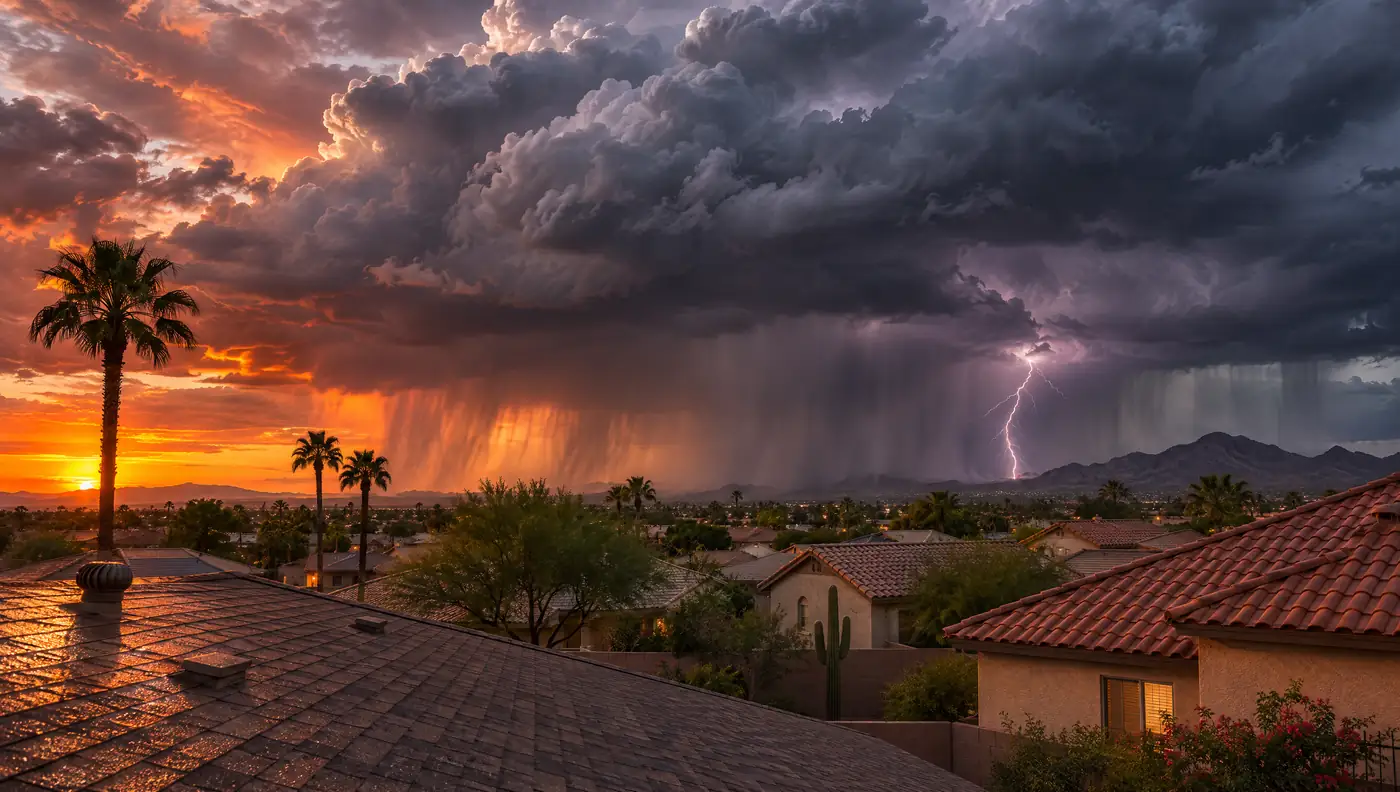
The monsoon season runs June 15 to September 30. The National Weather Service warns that storm outflows “can result in winds 50 mph or greater, and very dense blowing dust”. After a big storm, lifted or missing shingles are the thing to look for, and either one rules out treatment until a roofer fixes it.
Monsoon weather also limits treatment days. SoyLei’s application brochure tells applicators to check the forecast and hold off when rain, strong wind or severe weather is expected during or after the job. If a storm has just come through, a monsoon roof check is the right first step.
What you can check from the ground
- After a rain, look in the gutters and at the splash spots under downspouts. Dark, sand-like grit is shingle granules.
- Stand across the street and compare the slopes. The side that gets the most sun often looks the most faded.
- Look for edges that curl up, tabs that sit out of line, or dark patches where the surface looks smooth.
- Use your phone’s zoom and take photos. They help at an evaluation.
- Stay off the roof, above all in summer. The surface gets far hotter than the air, the footing is poor, and dry shingles don’t take kindly to being walked on.
For more on the hottest stretch of the year, read what 115 degree days do to asphalt shingles.
Your next step
If your shingles look dry or faded, start with a look, not a sales pitch. Read how roof rejuvenation works, then book a free roof evaluation. We’ll tell you whether your roof is a candidate, show you the photos, and share what the maker has and hasn’t published about heat.
Common questions
How hot does a shingle roof get in Phoenix?
The U.S. EPA says standard black asphalt roofs can reach 165 to 185°F at midday in summer, but that is a national figure. Lawrence Berkeley National Laboratory researchers put a black roof in full sun at roughly 61 to 90°F above the air. We found no published, measured shingle temperature for Phoenix itself. Lighter colors and shaded slopes run lower than a dark roof in full sun.
Does the soy treatment hold up at Phoenix roof temperatures?
No one has published that. SoyLei’s lab work used about 140°F, below what a dark Phoenix roof can plausibly reach, and we found no field data for the product in any desert climate. That is why we look at every roof first and ask SoyLei for its heat data in writing. Be wary of anyone who says a treatment is proven for Arizona heat.
Why does one side of my roof look worse than the other?
Sun exposure is the usual reason. The slopes that face the sun longest get more heat and UV, and more heating and cooling each day. InterNACHI, the home inspectors' association, says south-facing slopes have shorter lifespans for exactly that reason. We look at every slope separately during an evaluation, because one worn face doesn’t mean the whole roof is in the same shape.
Can a roof be treated in the middle of summer?
SoyLei publishes no maximum roof temperature for application, so we can’t quote you one. What SoyLei does say is to check the forecast and hold off if rain, strong wind or severe weather is coming, which rules out a lot of monsoon afternoons. In summer, work typically starts early in the morning. We’ll talk through timing with you at the evaluation.
Do granules in my gutter mean my roof is done?
Not on their own. Granules in the gutters tell you the shingles are shedding, which is part of how asphalt shingles age in strong sun. What matters is how much bare asphalt shows, whether shingles are cracked, curled or lifting, and whether the roof still keeps water out. That takes a closer look than a gutter can give you, so book an evaluation before you decide anything.