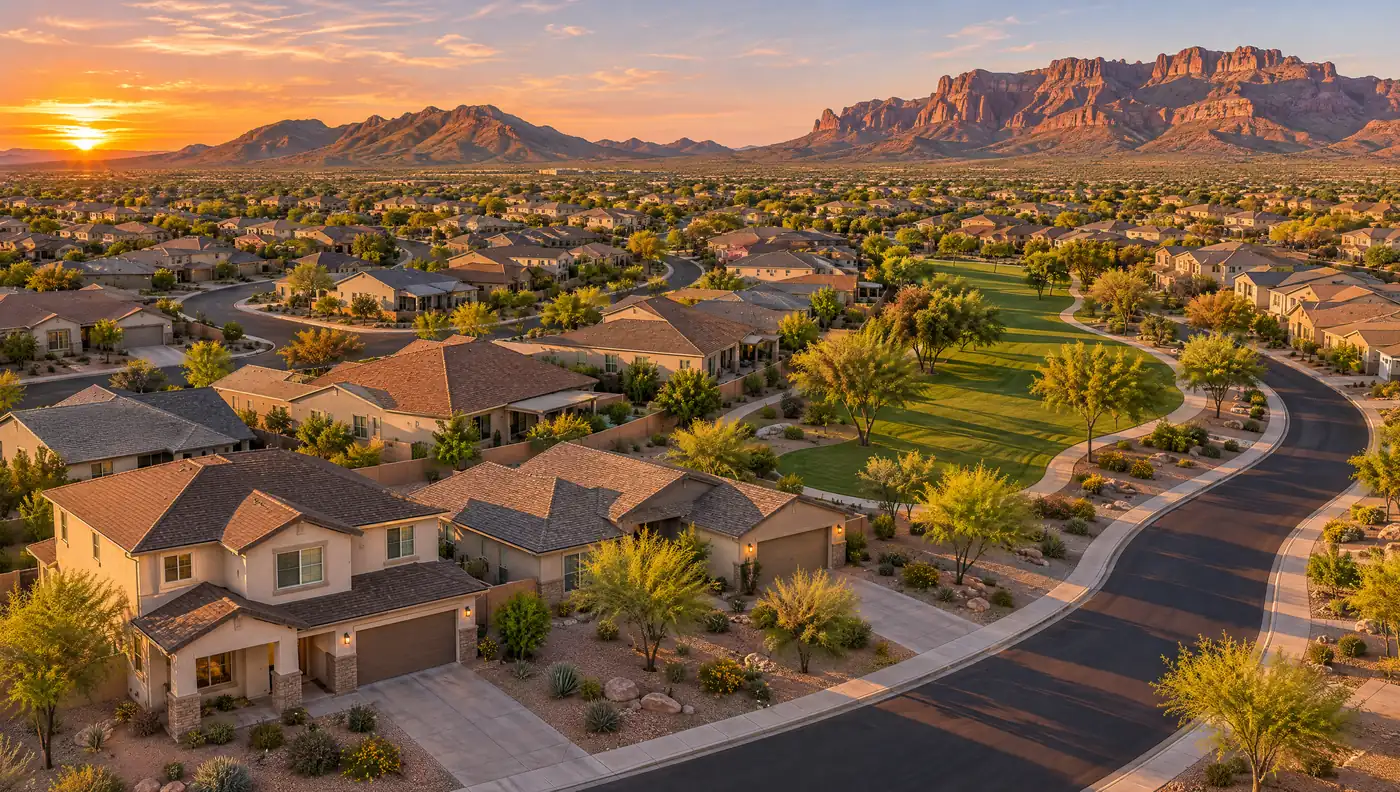
No place on our list has grown like Queen Creek. Census Bureau estimates put the town at 59,308 people in its 2020 base and 89,770 by July 2025, a jump of 51.4% (Vintage 2025). Its median home was built in 2012, and just 9% of its housing predates 2000 (ACS via Census Reporter).
Almost every house here is detached (94%) and lived in by its owner (90%). So if you own a Queen Creek home, the roof decision is probably yours, and the house is newer than most in the Valley. That changes the order of the questions. Here’s how we’d work through them.
First, is it shingle at all?
Many Valley homes have concrete tile, and rejuvenation isn’t made for tile. We treat asphalt shingles only, never tile, foam or metal. From the street, asphalt shingles look like thin, flat, overlapping strips with a gritty surface. Tile is thick, and often curved. Look from the street, or ask the builder what went on. If it’s tile, our tile and foam page is the place to go.
Second, how young is the roof?
On a newer house, the build year gives you a ceiling. A roof can’t be older than the house it sits on, though it may have been replaced since. With a median build year of 2012, plenty of Queen Creek roofs are likely on the young side.
SoyLei Innovations, the Ames, Iowa company that makes the treatment we use, recommends starting early. Its brochure says to “Apply APEX-1132™ within 3 years of new roof installation”, then to reapply every five years. That’s the maker’s advice. We report it, and we don’t promise results from it.
Third, what does your shingle maker say?
This matters most on a new roof. Some shingle manufacturers have published bulletins advising against field-applied rejuvenators, and a treatment can affect your shingle maker’s coverage. Owens Corning’s August 2026 technical bulletin is one example. Your builder or roofer should be able to tell you the brand. Read what that maker says, and decide with it in hand. Our FAQ on shingle makers goes deeper.
Fourth, what does your HOA allow?
If your neighborhood has an HOA, it gets a say. Axios Phoenix reported that in metro Phoenix, HOAs have long been “a popular way for developers to fund and maintain community infrastructure”. Architectural rules often come with them.
Looks are what a committee may care about. SoyLei says “Treated shingles may appear darker or refreshed after application, especially when the existing roof is sun-bleached.” Get your HOA’s answer in writing before you book. Our HOA and community roofs page has more on working with your association.
A committee will usually want to know what’s going on the roof and who makes it. The product name and maker, SoyLei’s product page, and a plain description of what happens on treatment day are a good start. We can give you all three.
What we can’t promise about the heat
A young roof still lives through Valley summers. The official Sky Harbor record shows 145 days at 100°F or more in 2020 (NWS Phoenix). SoyLei’s lab work simulated a summer roof at about 140°F, and it hasn’t published desert field data. We’d rather you know that going in.
Then book a look
Once you have those answers, read how roof rejuvenation works, or see the other Valley cities we cover. At the visit we confirm the roof type, look over the shingles, and, if it’s a fit, talk through timing with your HOA’s answer in mind. When you’re set, book a free roof evaluation and we’ll take it from your roof type on up.