The bank sign says 115. You squint at it, crank the AC and keep driving. Your roof doesn’t get that option. It sits out there all day, from the first 100 degree day in spring to the last one in fall.
A quick word on the number in the title. We picked 115 because that’s the kind of day people here remember. We couldn’t find an official yearly count of 115 degree days, so we won’t invent one. What the National Weather Service does track is 110. On 1991 to 2020 normals, Sky Harbor averages 21 days a year at 110°F or above and 111 days at 100°F or above. Then 2024 set the record, with 70 days at 110°F or higher (NWS Phoenix). The NWS called 2024 the warmest year recorded in the history of Phoenix (NWS Phoenix, 2024 recap).
So here’s one of those days, told from the roof’s side.
5 a.m.: the roof never really cooled off
Dawn in July isn’t cool in Phoenix. NOAA’s 1991 to 2020 normals put the average July low at Sky Harbor at 84.5°F (NOAA normals). The shingles start the day already warm.
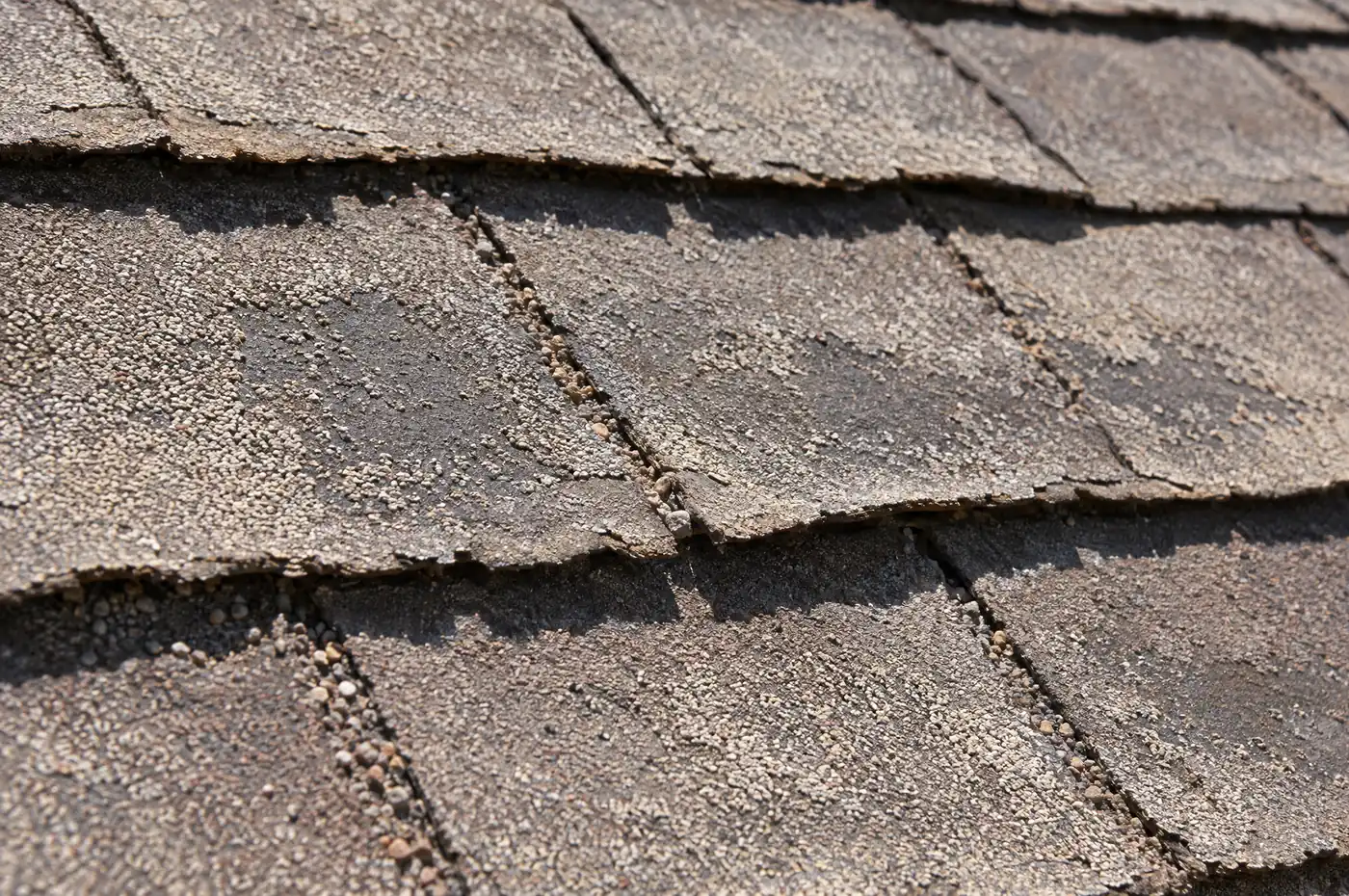
It helps to picture what a shingle is. It’s a mat soaked in asphalt, with a layer of small mineral granules pressed into the top. The asphalt keeps water out. The granules sit on top and take the sun so the asphalt underneath doesn’t have to. Everything that happens to the roof today is about those two layers and how well they hold together.
9 a.m. to noon: the sun climbs
By mid-morning the air is climbing toward the July normal high of 106.5°F. The roof is already well past that. Researchers at Lawrence Berkeley National Laboratory found that a black roof in full sun runs about 61 to 90°F warmer than the air around it (Berdahl and others, LBNL).
At midday, the EPA says, standard black asphalt roofs can reach 165 to 185°F in summer (EPA). That’s a national figure, not a Phoenix reading. We haven’t found anyone who has published measured shingle temperatures for Phoenix, and we’d rather tell you that than guess. InterNACHI, the home inspectors’ association, adds that darker roofs absorb more heat.
The light matters as much as the heat. The EPA’s UV index guide lists Phoenix’s typical summer midday UV index as 10, the top of the Very High band (EPA UV index guide). That’s the part of sunlight that does slow chemical damage to asphalt.
Noon to 3 p.m.: what’s going on inside the shingle
This is the stretch that ages a roof. The LBNL review of how roofing materials weather spells it out. Heat can “accelerate deleterious chemical reactions, cause loss of volatile constituents, and soften some polymers.” Over time, “As a result of oxidation, asphalt becomes harder and embrittled.”
The same paper describes a model for the oils in asphalt. Heat first pushes the lighter oils out of the bulk of the asphalt. Some evaporate. Others break down in sunlight and wash away in the next rain. Those oils are what let a shingle bend. InterNACHI puts it plainly: “Shingles become more brittle as volatiles, which keep them flexible, dissipate” (InterNACHI).
Then there are the granules, the shingle’s sunscreen. The LBNL authors write that for shingles to last, “it is essential that the roofing granules absorb the UV component of sunlight.” InterNACHI adds that as the volatiles go, the bond between asphalt and granules weakens and granule loss speeds up. Fewer granules means more UV on the asphalt. One problem feeds the next.
4 p.m.: the storm rolls in
From June 15 to September 30 it’s monsoon season (NWS Phoenix). Some afternoons a brown wall of dust shows up on the horizon. The NWS says the outflow from these storms “can result in winds 50 mph or greater, and very dense blowing dust” (NWS monsoon awareness).
Wind is the obvious threat. A brittle tab is more likely to crack than bend when a gust gets under it. Then the rain hits a roof that has been baking since breakfast. The LBNL paper names this exact moment. Temperature changes, “either gradual or sudden (rain shower on a hot day), cause stresses due to differential thermal expansion.” Brittle asphalt has less give to take that stress.
The runoff carries loose granules with it. After a storm, the bottom of your downspouts is often where they end up, as a little pile of dark grit.
After dark: the long, warm night
Once the sun drops, the roof starts giving its heat back. The air doesn’t help much. Remember that 84.5°F July low. The roof spends the night warm, then does it all again tomorrow.
That daily swing is its own kind of wear. InterNACHI says “Climates with large daily temperature swings shorten roof lifespans because they cause greater amounts of expansion and contraction.” It also notes that south-facing slopes age faster, from more thermal cycling and UV. If you only check one side of your roof, check that one.
Then do it again, all summer
The damage isn’t from one day. It adds up. On the 1991 to 2020 normals, here’s what a Phoenix roof gets each year (NWS Phoenix):
- The first 100°F day arrives around May 2 on average.
- The last one comes around October 5.
- In between, about 111 days at 100°F or above.
- About 21 of those reach 110°F or above.
- July’s average high is 106.5°F (NOAA).
And 2024 blew past the normals with 70 days at 110°F or more. Nobody can tell you exactly what one record summer took out of your particular roof. What the research does tell you is which way it pushes: drier asphalt, a weaker granule bond, and more stress every time the temperature swings.
What this means for your roof, and what it doesn’t
Heat ages every asphalt shingle roof in the Valley. That doesn’t mean every older roof needs replacing, and it doesn’t mean every roof can be helped. Telling the two apart is the point of an evaluation.
We use a soy-based rejuvenation treatment made by SoyLei Innovations of Ames, Iowa. SoyLei says its product is “engineered to penetrate asphalt shingles” (SoyLei). On the heat question we’ll be straight with you. SoyLei’s published study held treated shingles at 60°C, which is 140°F, to simulate summer roof temperatures (SoyLei’s published study). We haven’t seen desert field data from SoyLei, so we don’t claim the treatment holds up at any particular temperature. Read more about the treatment we use.
What you can do from the ground
A few things worth doing this week:
- Look at the bottom of your downspouts after the next storm. Some grit on an older roof is expected. A lot is worth a photo.
- Walk the yard after a big wind and look for shingle pieces.
- Use binoculars or your phone’s zoom on the south-facing slope first.
- Stay off the roof in summer. Leave the climbing to someone with the gear for it.
Storm just passed? Our monsoon roof check covers what to look for. For every Phoenix heat number in one place, see our guide to Arizona heat and asphalt shingles. And if your shingle roof has been through a few of these summers, book a free roof evaluation. We’ll tell you plainly where it stands.
Common questions
Why does the article say 115 if the weather service counts 110?
Because 115 is the number people remember from the bank sign. The NWS tracks days at 110°F or above: about 21 a year on 1991 to 2020 normals, and a record 70 in 2024. We didn’t find an official yearly count of 115 degree days, so we don’t quote one. For a shingle roof, the long run of hot days is what adds up.
How hot does a shingle roof get in Phoenix?
Nobody we’ve found has published measured shingle temperatures for Phoenix. The EPA says standard black asphalt roofs can reach 165 to 185°F at midday in summer, and that’s a national figure. LBNL research found a black roof in full sun runs about 61 to 90°F above the air temperature. Be wary of any exact Phoenix number online that doesn’t come with a source.
When should I get my roof looked at?
Any time of year works for a look. Monsoon season ends September 30, and after the storms is a sensible time to check for lifted or cracked tabs. If a treatment makes sense, SoyLei’s own guidance is to check the forecast and skip application when rain, strong wind or severe weather is expected. Start from the ground with the gutters and downspouts.