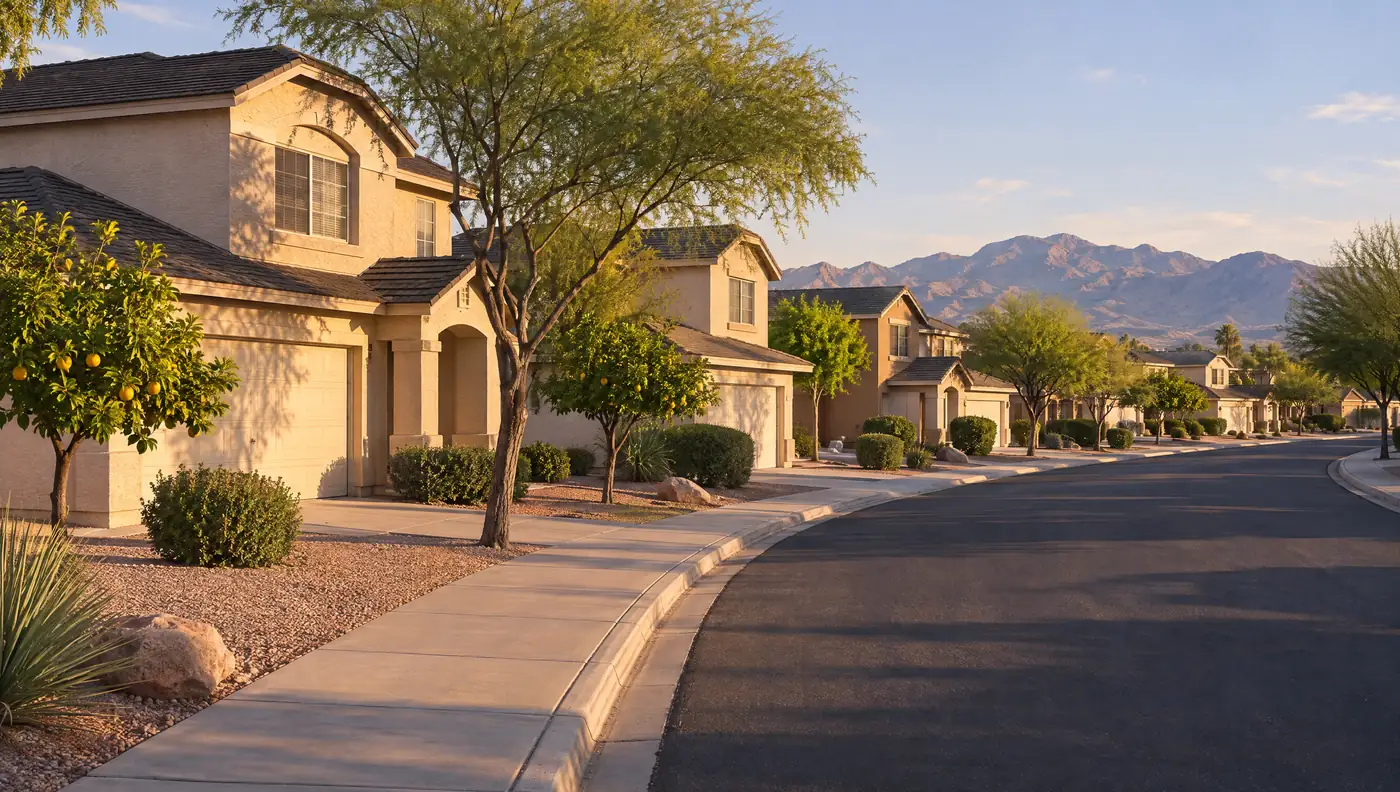
Goodyear has grown quickly. Census Bureau estimates go from a 2020 base of 96,141 residents to 125,359 in July 2025, an increase of about 30.4%. Most of the housing is recent. In the American Community Survey (2020 to 2024), the median Goodyear home dates to 2007, and only about 21% were built before 2000. Around 84% of housing units are detached houses and 78% of homes are owner-occupied. The median resident is 42.1 years old. Full tables are on Census Reporter.
Newer homes raise a different set of questions from older ones. This is the checklist we’d go through with a Goodyear owner.
Five checks before treating a newer roof
1. Is it asphalt shingle?
Plenty of Valley homes are roofed in concrete tile, and rejuvenation is for asphalt shingles only. We don’t treat tile, foam or metal. Unsure which you have? We’ll identify it. Tile owners can start with tile and foam roofs.
2. When did this roof go on?
Even on a newer home, the house’s year and the roof’s year can differ. A roof may have been redone after storm damage or before a resale. Your purchase documents might say. If you bought the house new from the builder, the roof is most likely the original and about as old as the house itself.
3. What does your shingle maker say?
This one weighs most on a young roof. Some shingle manufacturers have published guidance against field-applied rejuvenators. Owens Corning’s August 2026 technical bulletin is one. A treatment can affect what the maker will stand behind, so get its position in writing before you book.
4. What does your HOA allow?
If you pay HOA dues, check the rules on roof work and roof appearance first. Our HOA page explains why.
5. Is the timing right?
SoyLei Innovations, the Ames, Iowa company behind the soy-based treatment we use, favors early care. Its product brochure says to “Apply APEX-1132™ within 3 years of new roof installation” and to “reapply every five years.” That’s the manufacturer’s guidance, not a promise about how long any roof will last. Weigh it against what your shingle maker says in check three.
Young shingles, very high UV
New shingles get no break from the sun. The EPA’s UV index guide lists Phoenix’s typical summer midday reading as 10, in the “Very High” band. On that scale, 8 to 10 counts as Very High and 11 or more as Extreme. The granules on a shingle are what shield the asphalt underneath. Researchers at Lawrence Berkeley National Laboratory wrote that for asphalt shingles to weather well, “it is essential that the roofing granules absorb the UV component of sunlight.”
So granules collecting in gutters and at the bottom of downspouts deserve a closer look, even on a roof that isn’t old. Our post on signs your shingle roof is drying out covers what else to watch for.
New roofs and monsoon wind
Wind doesn’t check a roof’s age either. During the July 5, 2011 haboob, the NWS Phoenix office received “Widespread reports of near zero visibility and winds gusting over 50 MPH”, and “A few measured wind gusts even approached 70 MPH.” After a storm like that, lifted or missing shingles need a roofer’s repair before any treatment, on a roof of any age. See our monsoon roof check for what we look at.
Book your Goodyear evaluation
Goodyear is on our list of service areas. Once you’ve worked through the checklist, book a free roof evaluation. We’ll go over it with you, look at the shingles, and tell you plainly whether roof rejuvenation fits your roof yet. Want a ballpark in the meantime? Use the instant roof estimate.