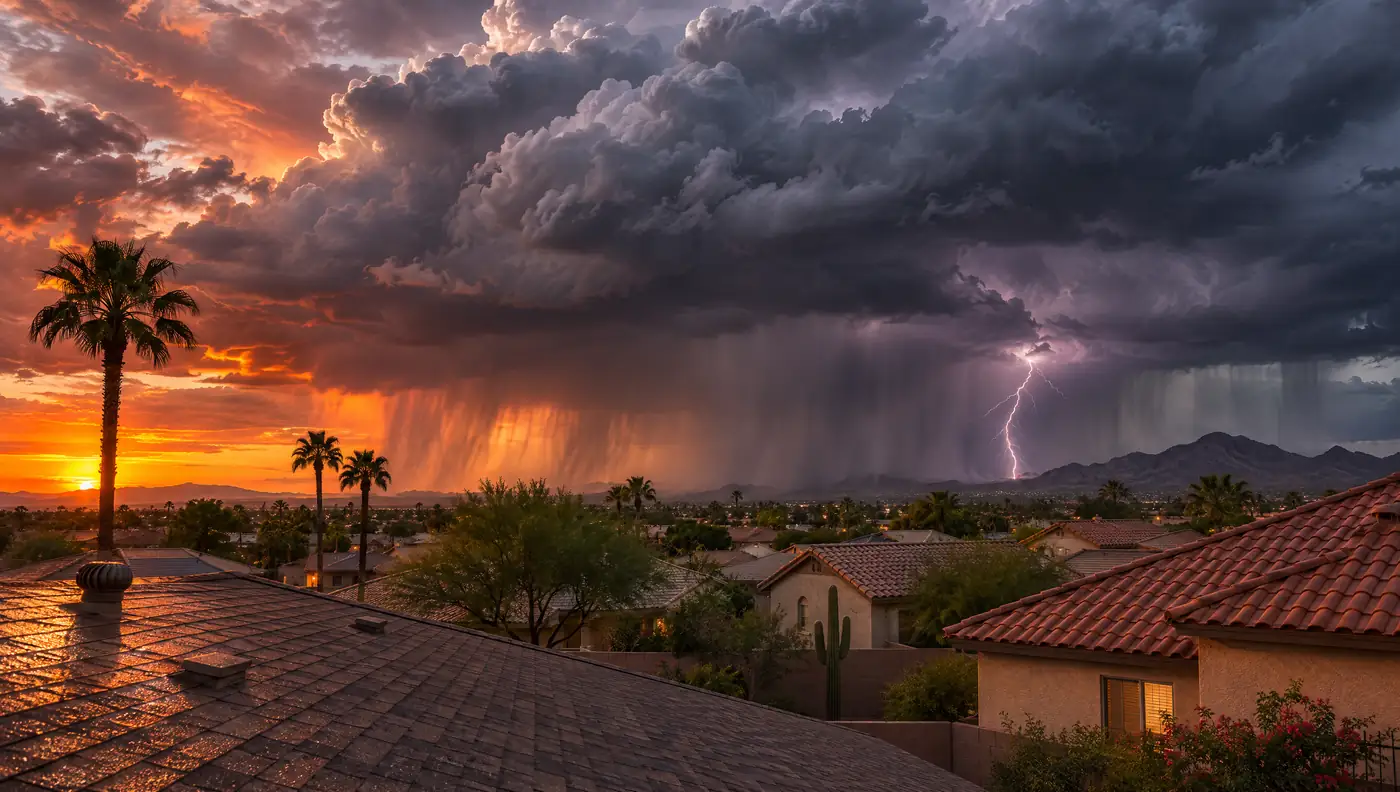
Monsoon season in Arizona runs from June 15 to September 30, according to the National Weather Service. Its Phoenix office warns that these storms “can cause damaging winds, torrential rainfall, frequent lightning, and dust storms.” Your shingle roof is the first thing all of that hits.
A monsoon roof check is a look at an asphalt shingle roof after the weather has done its worst. We get on the roof, photograph what we find and tell you what it means. If the roof needs a repair, we say so. We don’t do storm repairs and we don’t handle insurance claims, so the answer you get has no sales pitch attached.
What a monsoon storm does to a shingle roof
Wind
NWS Phoenix says thunderstorm outflow can bring “winds 50 mph or greater, and very dense blowing dust.” During the July 5, 2011 haboob, the office took reports of gusts over 50 mph, and “a few measured wind gusts even approached 70 MPH.” Gusts like that can catch the edge of a shingle and lift it. A tab that lifts can crease, tear or come off entirely.
Rain on a hot roof
A summer shingle roof can be far hotter than the air when a storm opens up over it. Researchers at Lawrence Berkeley National Laboratory note that temperature changes, “either gradual or sudden (rain shower on a hot day), cause stresses due to differential thermal expansion.” In plain terms, a hot shingle that gets doused cools fast, and that quick swing strains the material.
Dust and debris
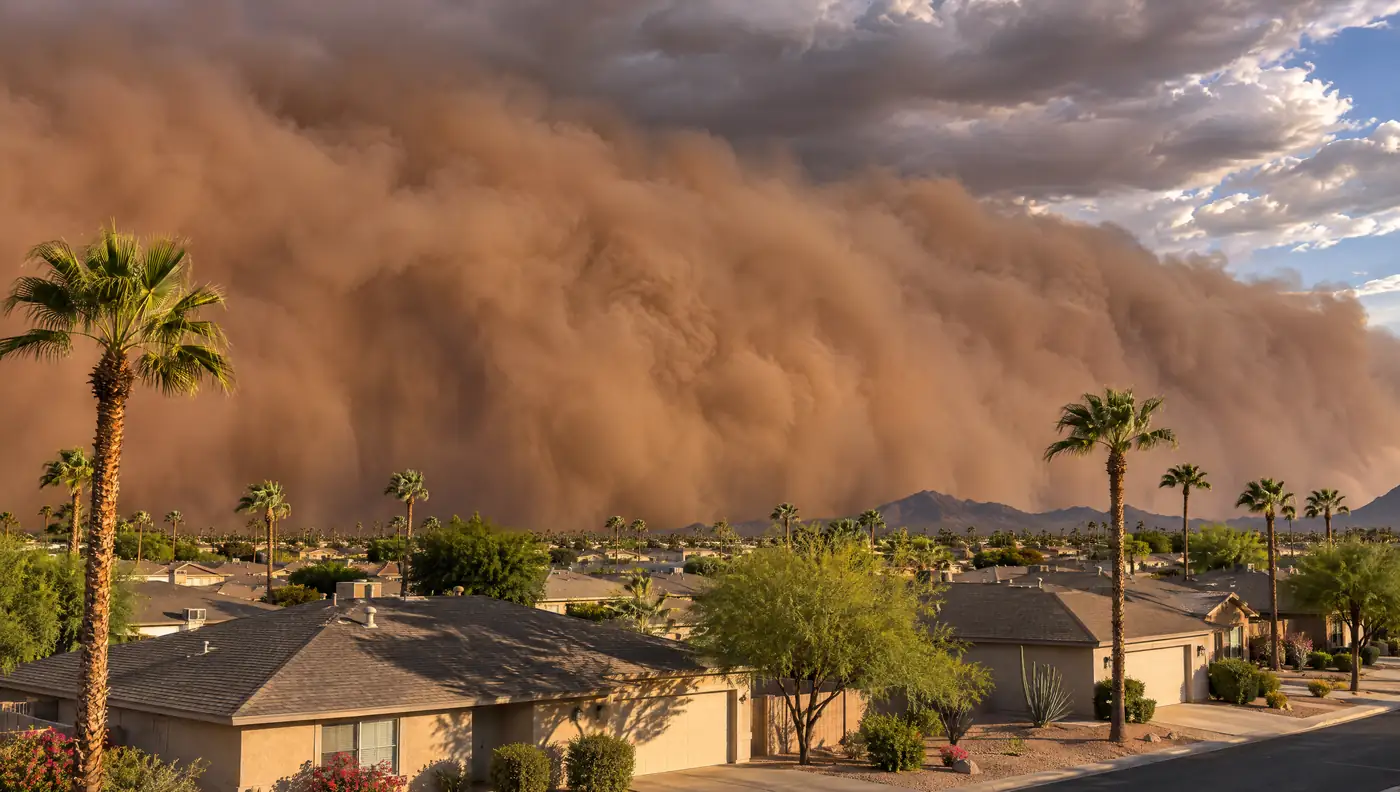
Haboobs carry dust and debris across the Valley. Branches, palm fronds and grit land on roofs and collect in the valleys, the channels where two slopes meet and where rain is supposed to run off. A valley full of debris slows that water down.
Granules on the ground
Heavy rain washes loose granules off the shingles and down the downspouts. A little grit is common on an older roof. A lot of it, or bare patches up top, means the shingles are losing their surface. Our page on why there are granules in your yard explains what’s normal and what isn’t.
What you can check from the ground
Please don’t climb up after a storm. The EPA says dark asphalt roofs can reach 165 to 185°F at midday in summer, and wet or loosened shingles slide underfoot. Stay on the ground and look for:
- Whole shingles or pieces of shingle in the yard, the pool or the street.
- Patches on the roof that look a different color, where shingles may be missing.
- Shingle edges sticking up along the ridge or the roof edges.
- Branches, fronds or piles of debris on the roof or in the valleys.
- Heaps of granules where the downspouts empty out.
- New stains on ceilings, or around vents and skylights inside the house.
Binoculars help. So does a zoomed-in photo from your phone. If you spot any of the above, get the roof looked at before the next storm rolls in.
What we check on the roof
Up top, we work across each slope and photograph as we go. We look for:
- Lifted or creased tabs, where wind has bent a shingle back on itself.
- Missing or torn shingles.
- Debris packed into valleys and against walls.
- Bare spots where the granules are gone and the mat shows.
- Flashing around vents, pipes and walls that has pulled loose.
- How the shingles bend. Brittle shingles crack where flexible ones give.
You get the photos and a short written summary of what we saw, so you know exactly where the roof stands after the storm.
When the answer is a roofer, not us
Some storm damage needs a repair, and we don’t do repairs. We also don’t handle insurance claims. If we find lifted, missing or torn shingles, a leak or loose flashing, we photograph it, tell you it’s a job for a roofer, and you’re free to share our photos with whichever roofer you choose.
We won’t treat a roof that has storm or impact damage that hasn’t been repaired. Rejuvenation is meant for sound roofs, and SoyLei, the Ames, Iowa company that makes the product we use, describes it as preservation, not emergency repair.
Once the roof is sound
After any repairs are done, the next question is whether the shingles themselves are worth treating. That’s what roof rejuvenation is for: an aging asphalt shingle roof that still keeps water out, where the shingles have dried out and stiffened.
Timing matters in monsoon season. SoyLei’s application brochure says to “confirm there is no rain, strong wind, or severe weather expected during or after application.” So we watch the forecast and book spray days around the storms, not into them.
Recent storms around the Valley
Monsoon damage isn’t rare here. In its 2024 year in review, NWS Phoenix describes “a series of microbursts around the Phoenix metro on July 24th that caused a warehouse to collapse.” It also lists a larger downburst on August 6 that caused wind damage around McCormick Ranch, and a large dust storm on August 22 with isolated wind damage across the metro.
Not every storm hurts a roof. But after a season like that, it’s worth knowing what yours looks like before the next one.
Book a monsoon roof check
Book a free roof evaluation and tell us a storm came through. We’ll get on the roof, photograph it and give you a straight answer. For a list you can work through yourself, see our monsoon season roof checklist.
Common questions
Do you handle insurance claims for storm damage?
No. We don’t file claims, meet adjusters or do storm repairs. What we can do is get on your roof, photograph what the storm did and tell you plainly what we saw. The photos are yours to share with a roofer or anyone else you choose. If the roof needs a repair, a roofer is the right call, and we’ll say so.
Should I get on the roof myself to look?
We’d rather you didn’t. In summer, a dark shingle roof gets far hotter than the air, and storm-loosened shingles and debris make for poor footing. Most of what matters shows up from the ground: pieces of shingle in the yard, edges sticking up, debris in the valleys and granules at the downspouts. Leave the climbing to us.
Can you treat my roof during monsoon season?
Sometimes, on the right day. SoyLei says to check that no rain, strong wind or severe weather is expected during or after application, and in a monsoon summer that rules out some days. We check the roof first, make sure any storm damage has been repaired by a roofer, and then book a day with a clear forecast. If the forecast turns, we move the date.
Do you check tile roofs after a storm?
No. We work on asphalt shingle roofs only. Tile and foam roofs are different systems, and a roofer who works on those is the right person to check them after a storm. If you’re not sure what your roof is made of, ask us when you book and we’ll help you work it out.