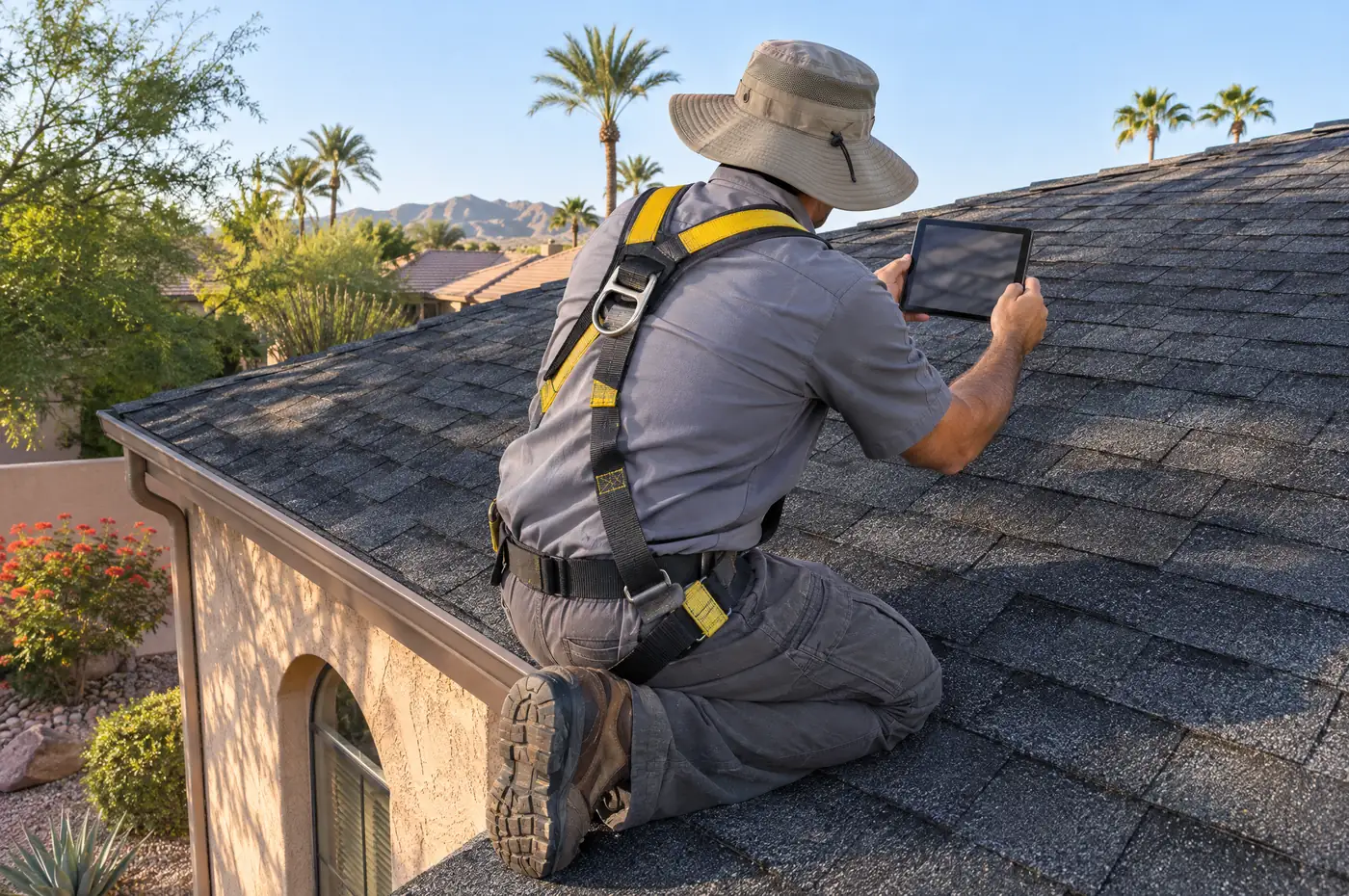
A treated roof still sits under the Arizona sun. So does a roof that wasn’t ready for treatment the first time we looked. Either way, the question about your roof doesn’t go away. It just moves further down the calendar.
The roof care plan is how we keep an eye on it for you. We come back, get on the roof, photograph it and compare it with the last visit. You hear what changed, if anything, and what we’d do about it. It’s for asphalt shingle roofs only, and we set it up around your roof and your year, not around a sales target.
What a care visit includes
- A return look. Someone gets back on the roof and checks the shingles by hand, the same way as the first visit: how they bend, how they’re holding granules, and any cracking, curling or lifted tabs.
- Photos every time. Taken from the same spots where we can, so you can see the roof change over months and years instead of guessing.
- A look after monsoon season. The season runs June 15 to September 30. Once it’s over, we check for lifted or missing shingles and storm debris. Here’s what that monsoon roof check covers.
- Clear valleys. We clear loose debris from the valleys and the roof surface while we’re up there, so rain has a path off the roof.
- A short note. What changed, what didn’t, and what we’d suggest next.
Re-treatment only when the roof needs it
We don’t re-treat on a timer. SoyLei Innovations, the Ames, Iowa company that makes the product we use, gives its own guidance. Its product brochure says to apply APEX-1132 within three years of a new roof and to reapply every five years. That’s the maker’s schedule. It says nothing different for desert heat, and SoyLei hasn’t published field data from Arizona.
So we follow SoyLei’s guidance, and we look first. If the shingles still bend and hold their granules, we tell you to wait. If they’ve stiffened again and the roof is still sound, we talk about a second treatment. If the roof has moved past what a treatment can help, we say that instead. For more on timing, read how long roof rejuvenation lasts.
Why a second look matters in the Valley
Phoenix’s hot season is long. NWS Phoenix puts the average first 100°F day at May 2 and the average last one at October 5, based on 1991 to 2020 data. That’s a stretch of about five months when triple digits are normal. The EPA lists Phoenix’s typical summer midday UV index as 10, “Very High.”
Not every slope ages at the same pace, either. InterNACHI, an inspectors’ trade group, notes that “South-facing roof slopes have shorter lifespans due to increased thermal cycling and UV exposure.” That’s why we photograph every slope on each visit, not just the side you see from the street.
Who the care plan suits
- Busy owners who want someone else to keep track of the roof.
- Snowbirds who leave the Valley for the summer and come back in the fall to whatever the monsoon left behind.
- Landlords and rental owners who can’t get on every roof themselves and want photos on file.
- Owners we told to wait. If your roof wasn’t ready for treatment, a care visit tells you when it is.
- Owners of treated roofs who want to know how the shingles are holding up.
What the plan doesn’t do
- It doesn’t include repairs or replacement. We don’t do either. If we find damage, you get the photos and a clear “call a roofer.”
- It isn’t a promise about how long your roof will last. Nobody can honestly make that promise.
- It doesn’t cover tile, foam or metal roofs.
- It doesn’t commit you to a re-treatment. That decision waits until we’ve been up there and talked it through with you.
Getting started
Every care plan starts with a free roof evaluation, so there’s a first set of photos to compare against. If you haven’t had the treatment yet and want to know what it involves, start with our roof rejuvenation page.
Common questions
How often will you come back?
We set that with you at the start, based on the roof and how you use the house. A natural time is after monsoon season ends on September 30, when any storm damage is fresh and easy to spot. We won’t put your roof on a fixed timetable we can’t explain. If something changes, like a big storm, you can ask us to come out sooner.
Will you re-treat my roof automatically?
No. A second treatment only happens after we’ve been on the roof, looked at the shingles and talked it through with you. SoyLei publishes its own reapplication guidance and we follow it, but the roof decides. If the shingles don’t need it yet, we tell you to wait and we look again next time.
Do I need to be in town for a visit?
Usually not, as long as we can get to the roof and you’ve told us how. That’s what makes the plan work for snowbirds and rental owners. We send you the photos and our note after each visit, so you see what we saw from wherever you happen to be.
What happens if you find damage on a care visit?
We photograph it, show you where it is and tell you plainly that it needs a roofer. We don’t do repairs, so we’re not the ones selling you the fix. Once the repair is done, we can come back and look again before any treatment is on the table.