Ask three Scottsdale neighbors what’s on their roof and you could get three answers. Concrete tile. Asphalt shingles. A flat roof nobody has looked at in years. Rejuvenation is for only one of those. We treat asphalt shingle roofs and nothing else, so the first thing we do at any Scottsdale address is confirm the roof is shingle.
If it is, the next question is how old the shingles are. That’s a different number from the year the house went up. A home built in 1991 may still wear its first roof, or it may be on its second. Only a look at the roof itself settles it.
A city of mixed housing
The Census Bureau’s American Community Survey (2020 to 2024) gives a useful sketch. The median Scottsdale home was built in 1991, and about 73% of homes went up before 2000. Only 52% of housing units are detached single-family houses. The rest is everything else: townhouses, condos, apartments and other housing types. About 67% of occupied homes are owner-occupied. The figures are on Census Reporter’s Scottsdale profile.
The city isn’t adding many people. Census estimates put Scottsdale at 241,326 residents in the 2020 base and 243,006 in July 2025. Its residents are older than the county’s, too, with a median age of 49.0 against 37.6 for Maricopa County. In short, most roofs here sit on houses that have been standing a while.
Who has a say about your roof
On a detached house you own, the roof decision is mostly yours. On an attached home it often isn’t. Shared roofs and townhouse rows are often handled by an association, and plenty of detached homes sit inside an HOA with rules about how a roof looks. A treated roof can look a little different from the street, which is why we cover roof color after treatment and HOA and community roofs on their own pages.
Your shingle maker has a say as well. Some shingle manufacturers, Owens Corning among them, have published technical bulletins advising against field-applied rejuvenators. Read your shingle paperwork, or ask the maker in writing, before any treatment goes on. We’d rather you hear that from us now than discover it later.
Three questions, in this order
- Is it asphalt shingle? If it’s tile or foam, rejuvenation isn’t the answer. Our page on tile and foam roofs explains what we tell those owners.
- Are the shingles still whole? Dry and faded is one thing. Torn, lifted or missing shingles need a repair first, and an active leak needs a roofer.
- Who else needs to sign off? Your HOA, your shingle maker, or both.
If all three answers line up, we’ll walk you through how roof rejuvenation works on your roof in particular, not a generic one.
Desert sun on a Scottsdale roof
The closest long-running weather record is at Phoenix Sky Harbor. Its 1991 to 2020 figures show 111 days a year at 100°F or hotter and 21 days at 110°F or hotter, according to the National Weather Service in Phoenix. The EPA says standard black asphalt roofs can reach 165 to 185°F at midday in summer. That’s a national figure, not a Scottsdale measurement, but it shows what dark shingles sit through here.
The treatment we use is made by SoyLei Innovations of Ames, Iowa, from soybean oil. SoyLei is clear about what it isn’t: “It is not paint, not a roof coating, and not a film-forming sealcoat.” One more thing worth saying plainly. SoyLei’s published lab work used conditions of about 140°F, and the company has published no field data from the desert. We tell every Scottsdale owner that up front.
Book a look at your Scottsdale roof
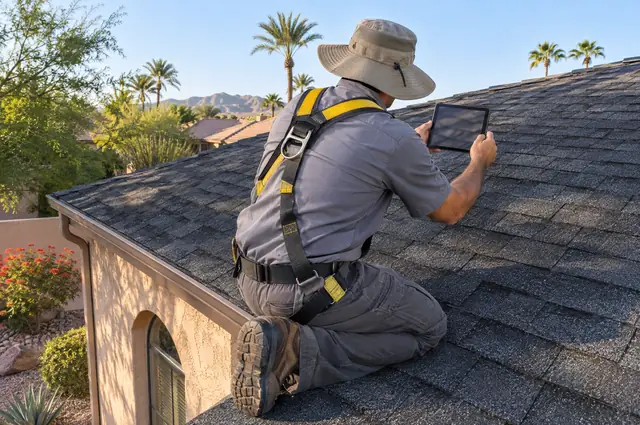
A free roof evaluation answers the three questions above. We confirm the roof type, look over the shingles, and tell you straight whether rejuvenation fits. If it doesn’t, you’ll hear that too. Curious about nearby cities? See all our service areas. Want a ballpark before anyone visits? Try the instant roof estimate.