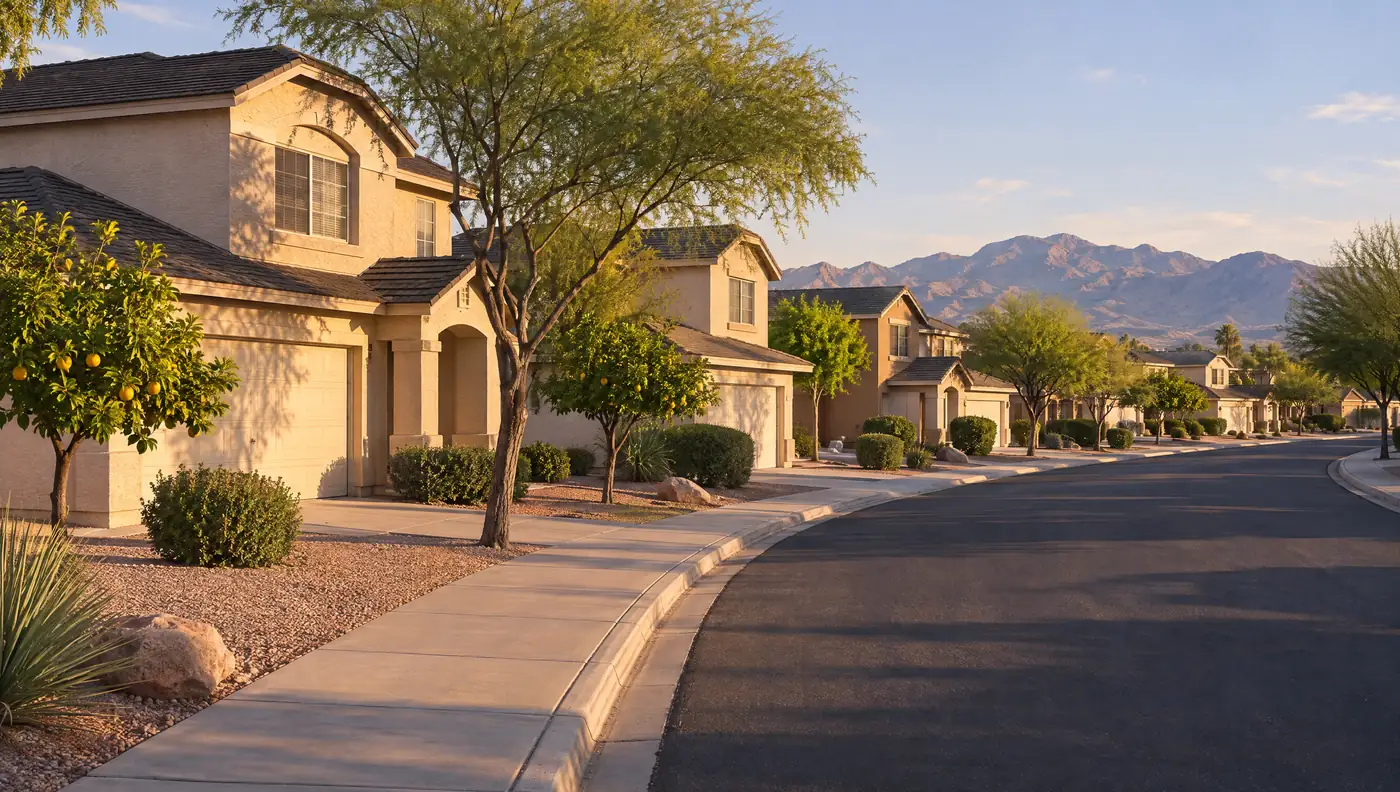
Gilbert is a town of houses. In Census survey figures for 2020 to 2024, 82% of its housing units are detached single-family homes, and 73% of occupied homes are lived in by the people who own them (ACS via Census Reporter). That’s a lot of owners, each with one roof to look after.
The town is still growing. Census Bureau estimates have Gilbert at 267,875 people in its 2020 base and 287,285 by July 2025, up about 7.2% (Vintage 2025).
Two generations of houses
Gilbert’s median home was built in 2003. About 40% of its housing predates 2000, and 36% was built from 1980 to 1999. The rest came after. So the town has older streets and newer ones.
Take the build year as a hint about your street. It isn’t your roof’s birthday. Roofs get swapped out along the way, and you won’t know what’s on yours until someone looks.
If your house is one of the newer ones, there’s one more thing to check. Some shingle makers have published bulletins against field-applied rejuvenators, Owens Corning’s among them, and a treatment can affect what the maker covers on a younger roof. Our FAQ on shingle makers explains what to ask before you book.
Why your neighbor’s roof isn’t a guide
Same builder, same year, same shingle color, and two Gilbert roofs can still wear differently. Direction is one reason. InterNACHI, a trade group for inspectors, says “South-facing roof slopes have shorter lifespans due to increased thermal cycling and UV exposure.” One house puts a big slope toward the south. The one across the street may not.
Other things pull neighbors apart too. Shade from a tree. A past repair. One roof that was replaced and one that wasn’t. That’s why we look at each roof on its own.
Compare your roof with itself
Here’s a check you can do from the yard. Walk around the house and look at each roof slope in turn. Does the south side look lighter or more faded than the north? Is there more grit in the gutter or on the ground below one slope than another? Are the edges of the shingles flat on one side and curling on the other?
If one slope looks older than the rest, tell us when you book. That’s often where we start. Our candidate checklist has more signs to look for.
A hot season five months long
Gilbert shares the Valley’s long hot season. At Phoenix’s official station, the average first 100°F day falls around May 2 and the last around October 5 (1991 to 2020, NWS Phoenix). Every one of those days heats your shingles up and lets them cool back down. InterNACHI ties that kind of daily swing to expansion and contraction in the roof.
We’ll be straight about the treatment and heat. SoyLei Innovations, the Ames, Iowa maker of the product we use, ran its lab tests at about 140°F and has published no desert field data. So we don’t make promises about how it holds up through a Gilbert summer.
Shingle first, then the HOA
Lots of Valley homes have tile roofs, and we treat asphalt shingles only. If you aren’t sure what’s on yours, send a photo or let us check at the evaluation. Our tile and foam roofs page covers the rest. If your street has an HOA, read its rules on roof work before you schedule anything. The HOA and community roofs page explains what to ask.
Getting a Gilbert roof looked at
Gilbert is one of the East Valley areas we cover. Read up on how roof rejuvenation works, and try the instant estimate if you want a starting number. Then book your free roof evaluation. We’ll judge your roof on its own terms.