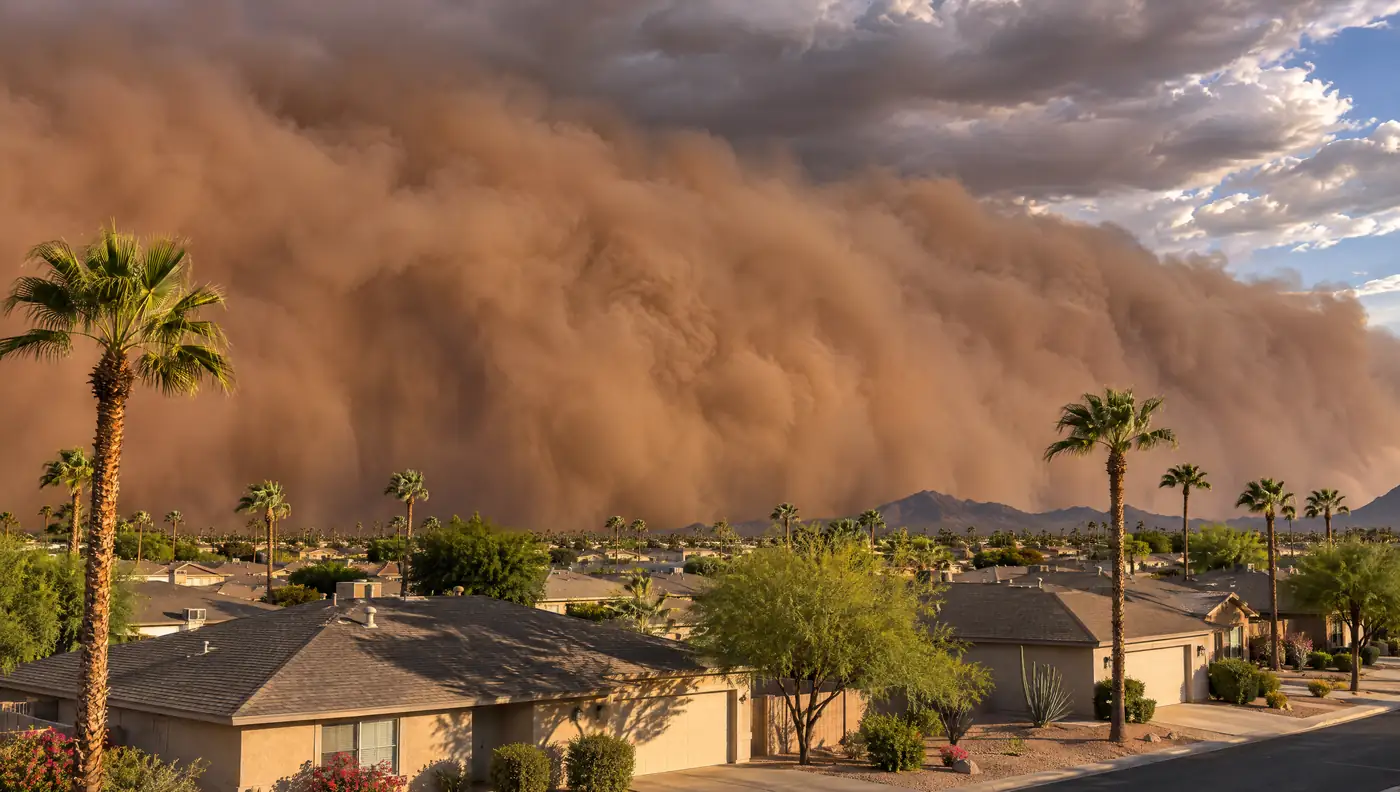
Phoenix doesn’t get much rain. NOAA’s 1991 to 2020 normals put Sky Harbor at 7.22 inches a year (NOAA normals). The trouble is how it arrives: in the middle of summer, often all at once, with wind and a wall of dust out in front. The NWS notes that in some areas, over half the year’s rain falls during the monsoon (NWS).
The official season runs June 15 to September 30 (NWS Phoenix). For a shingle roof that has spent the spring baking, that’s when the weak spots show. Here’s a checklist you can work through from the ground, in three parts.
Before June 15
- Clear the gutters and downspouts. A storm can drop a lot of water fast. Gutters packed with dust, leaves and granules back up and spill over the edge, right where you don’t want water.
- Clear the valleys. A valley is the channel where two slopes meet and the water runs together. Leaves and debris piled there slow the water down and hold it against the shingles. If you can’t reach a valley from a ladder at the eave, have someone else do it.
- Trim branches over the roof. Outflow winds can top 50 mph, per the NWS. A branch that brushes the shingles on a calm day will slap them in a storm, and a dead limb can come down on them.
- Take before photos. Walk around the house and photograph every slope from the ground, with the date. If a storm does damage later, you’ll have a record of how the roof looked.
- Look for loose or lifted tabs now. A tab that’s already loose in May is a likely candidate to go in July. Get it fixed by a roofer before the season starts.
During the season
In the NWS’s words, monsoon storms bring “damaging winds, torrential rainfall, frequent lightning, and dust storms.” The outflow ahead of a storm “can result in winds 50 mph or greater, and very dense blowing dust” (NWS Phoenix monsoon page). On July 5, 2011, a few measured gusts in the big Phoenix dust storm approached 70 mph (NWS Phoenix).
These aren’t once-a-decade events. In 2024 alone, the NWS recorded microbursts around the metro on July 24 that collapsed a warehouse, a downburst with wind damage around McCormick Ranch on August 6, and a large dust storm with isolated wind damage on August 22 (NWS Phoenix, 2024 recap).
- Stay off the roof. Between the heat and the wind, it’s no place for a homeowner in July or August.
- After heavy rain, look at your ceilings for any new stain or damp spot.
- Clear the downspouts again after a dust storm. Dust plus rain makes mud, and mud plugs a downspout.
- When a storm or dust storm warning goes out, there’s nothing to do on the roof. Get inside and deal with the roof after it passes.
The morning after a storm
- Walk the yard. Look for shingle pieces, branches, and dark grit washed out at the bottom of the downspouts.
- Look at every slope from the ground. Use binoculars or a phone zoom. You’re looking for missing shingles, tabs sitting up off the row below, and shingle lines that look wavy.
- Check inside. Look at the ceilings, and the attic if you can get into it, for new stains or damp spots.
- Photograph everything before anyone touches it. Wide shots and close-ups, with the date. If you file an insurance claim, those photos are your record of what the storm did.
- Call a roofer for damage. Anything missing, torn, lifted or leaking is repair work, and it comes first.
Who to call for what
| What you see | Who to call | Why |
|---|---|---|
| Missing, torn or lifted shingles | A roofer | Repairs come first |
| A leak or a new ceiling stain | A roofer, soon | Water inside is a repair job |
| Impact damage after a hard storm | A roofer, with your photos | Impact damage rules out a treatment |
| Grit at the downspouts, faded shingles, everything flat and whole | Us | A dry but sound roof is what rejuvenation is for |
That split is on purpose. We don’t do storm repairs or insurance work. SoyLei Innovations of Ames, Iowa makes the soy-based treatment we use, and SoyLei calls it a treatment, “not a replacement for repairs” (SoyLei). Its guidance also says not to apply it to roofs with “hail or impact damage.”
Timing matters too. SoyLei’s application guidance says to check the forecast and confirm “there is no rain, strong wind, or severe weather expected during or after application” (SoyLei application guidance). In the middle of monsoon season, that means picking the day with care, and sometimes waiting for fall.
After the season
Once September 30 has come and gone, give the roof one more look from the ground. Compare it with your before photos. Look at the gutters and downspouts for grit, and at the south-facing slope, which takes the most sun.
Our monsoon roof check covers a shingle roof after storm season, up close, with photos of anything we find. Or book a free roof evaluation any time, and we’ll tell you whether your roof needs a roofer, a treatment, or nothing at all. If you’d like a rough number first, try the instant roof estimate.
Common questions
When is monsoon season in Phoenix?
The NWS puts the official season at June 15 to September 30. Storms don’t follow the calendar exactly, but that’s the window to plan around. Do your gutter, valley and branch work before mid-June, then do a ground check after each big storm through the end of September, and one last look once the season is over.
Should I get my roof treated before monsoon season?
Only if the roof is sound going in. A treatment doesn’t repair anything, so loose, lifted or cracked shingles need a roofer first. SoyLei’s own guidance says to apply only when no rain, strong wind or severe weather is expected during or after application, and that narrows the choice of days in July and August. For a lot of roofs, after the season is the simpler time.
Who do I call if a storm damaged my shingle roof?
A roofer. Missing, torn or lifted shingles and leaks are repair work, and they come before anything else. Photograph the damage from the ground first, with the date, in case you file an insurance claim. We don’t do storm repairs. Once the roof is repaired and sound, a treatment may be worth talking about, and we’re glad to take a look then.