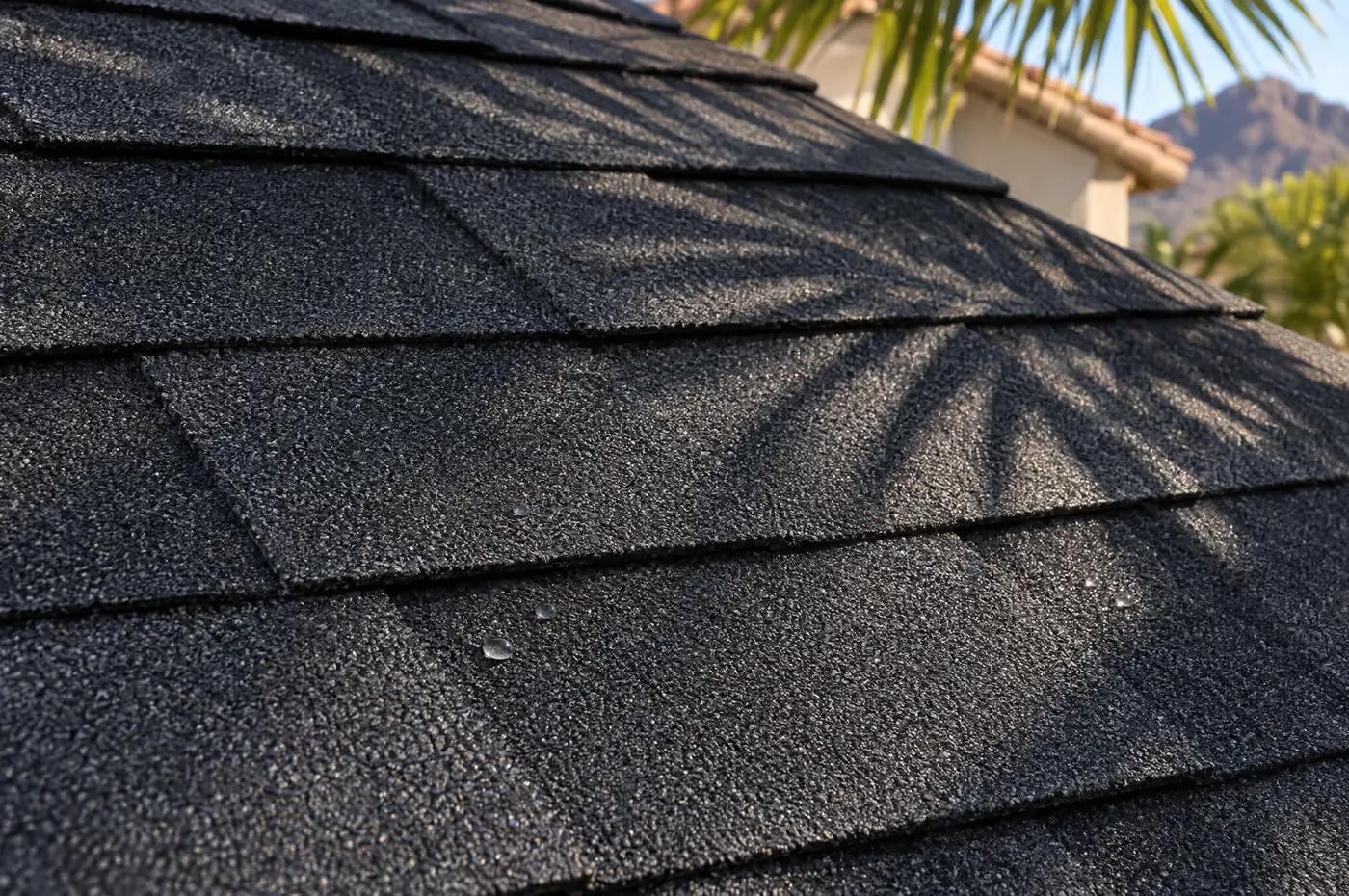
Mark Voorhies already runs a court resurfacing business in the Phoenix area: pickleball, tennis and basketball courts. The crews, trucks and spray equipment behind Shingle Restore Pro come from that trade. So when he started looking at shingle roofs, the spraying part was familiar ground. Choosing what goes in the sprayer was the real decision.
Here’s how we thought it through, and where we landed.
What we were looking for
Something that goes into the shingle, not on top of it
A dry shingle has lost the lighter oils that keep its asphalt flexible. That’s the research, not a sales line. InterNACHI, the home inspectors’ association, says “Shingles become more brittle as volatiles, which keep them flexible, dissipate” (InterNACHI). We wanted a product made to soak into the asphalt. Not a paint, and not a film that sits on the surface. That’s a different kind of product for a different job.
Made for asphalt shingles
Phoenix homes have a mix of tile, shingle and flat foam roofs, and we only treat shingles. So we wanted a product whose maker says plainly that it’s for asphalt shingles. SoyLei says its product “is for asphalt-shingle roof maintenance” (SoyLei).
A maker that shows its work
We wanted a manufacturer that publishes its paperwork: what’s in the product, how to apply it, and the testing behind it. SoyLei posts its safety data sheet, its application guidance, outside lab reports and a peer-reviewed study on its own website. Not all of it reads like a sales brochure. That’s part of why we were comfortable choosing it.
What SoyLei says about its product
SoyLei Innovations is based in Ames, Iowa. It says APEX-1132 “was created by researchers from Iowa State University,” and that the inventors founded the company and still make and support the product (SoyLei). Here’s how SoyLei describes it:
“It is a spray-applied rejuvenation treatment, not a replacement for repairs or a film-forming roof coating.” SoyLei product page
SoyLei says the product is “engineered to penetrate asphalt shingles, restore shingle flexibility, improve granule adhesion.” It’s built on semi-epoxidized soybean oil, which SoyLei shortens to SESO, and it’s mixed with water before spraying. SoyLei explains the chemistry this way: “Epoxidation converts some of those double bonds into oxirane rings. That reduces the number of conventional oxidation sites and adds polar, potentially reactive functionality” (SoyLei).
In plain terms, SoyLei’s argument is that a treatment has to hold up after it’s on the roof, and that its chemistry is designed with that in mind. SoyLei makes a point we agree with: “an initial drop in stiffness does not tell us what happens after exposure to oxygen, summer roof temperatures, water, ultraviolet light, and repeated heating and cooling.” That’s the question we keep asking, too.
What we don’t take on faith
Being open about the limits is part of why we picked this product. Here’s what the record shows.
What the testing does and doesn’t tell us
- The heat question. SoyLei’s published study held treated shingles in a 60°C oven, which is 140°F, to simulate summer roof temperatures (SoyLei’s study). The EPA says standard black asphalt roofs can reach 165 to 185°F at midday in summer, as a national figure (EPA). We haven’t seen SoyLei publish field data from Arizona or any desert climate. We’d like to, and until we do, we don’t claim the treatment holds up at any particular temperature.
- Who did the research. Several authors of that peer-reviewed study own shares in SoyLei, and the paper says so. The authors also say future work should include field testing under natural weather to confirm long-term performance. We take them at their word.
- How long it lasts on your roof. No field study we’ve seen shows how much time a treatment adds to any one roof, so we don’t put a number on it.
What we tell every customer up front
- Handling. SoyLei’s safety data sheet carries the signal word “Danger” and warns that the product causes serious eye damage and may cause an allergic skin reaction (SoyLei SDS). We follow the SDS, wear protective gear, and cover plants, cars and windows against overspray.
- Shingle makers. Some shingle manufacturers, Owens Corning among them, have published bulletins warning against field-applied rejuvenators and coatings (Owens Corning bulletin). A treatment can affect what your shingle maker will cover. Better you hear that from us now than find out later.
What we still check on every roof
Picking a product was one decision. Whether it goes on your roof is another, and we make that one fresh every time.
- It has to be an asphalt shingle roof. Tile and foam go to other trades, and here’s why.
- The roof has to be sound: no leaks, no soft decking, no torn, missing, lifted or cracked shingles, and no bare mat showing. SoyLei’s own guidance rules out all of those.
- Your shingle maker’s position and your HOA’s rules. Axios, citing Realtor.com, reported that nearly three-quarters of Valley home listings in 2024 included HOA fees (Axios Phoenix). SoyLei says treated shingles “may appear darker or refreshed after application,” which is the kind of change an HOA may want to know about.
- The forecast. SoyLei’s application guidance says to confirm “there is no rain, strong wind, or severe weather expected during or after application” (SoyLei application guidance).
If any of those don’t line up, we don’t spray. For more on how the treatment works and what it isn’t, see our page on the soy-based roof treatment. To find out whether your roof qualifies, book a free roof evaluation.
Common questions
Is the soy-based treatment a coating?
SoyLei says it isn’t. It describes its product as "not paint, not a roof coating, and not a film-forming sealcoat," and says it’s mixed with water and sprayed on to penetrate the shingle. That’s the maker’s description. Owens Corning’s bulletin covers rejuvenators as well as coatings, so it’s worth checking your shingle maker’s position either way.
Why soybean oil?
SoyLei, which grew out of research at Iowa State University, builds its product on semi-epoxidized soybean oil. SoyLei’s case is that the epoxidation step leaves the oil with fewer of the sites where oxidation starts. That’s the maker’s reasoning, based on lab work, not a desert field result. We chose it because it’s made for asphalt shingles and the maker publishes its testing.
Does the treatment work in Phoenix heat?
We can’t give you a sourced yes, and we won’t fake one. SoyLei’s published lab testing used about 140°F to simulate a summer roof. The EPA says black asphalt roofs can reach 165 to 185°F at midday in summer, nationally. We haven’t seen desert field data from SoyLei. What we can do is check your roof, tell you what we see, and show you the maker’s paperwork.