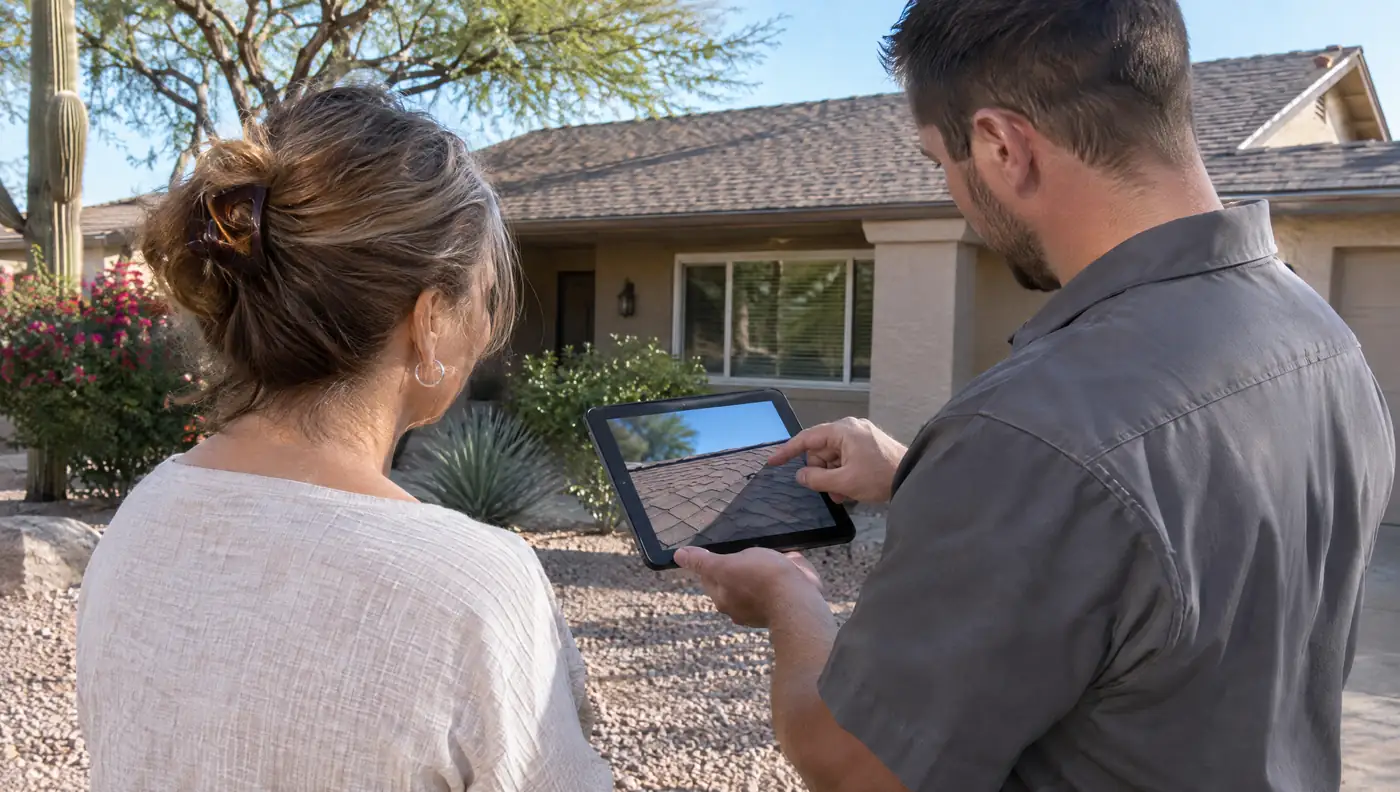
A roofer came out, walked the roof and left you a quote for a new one. Maybe it’s right. Plenty of Phoenix shingle roofs do need replacing. But a roof can look tired from the street, faded and shedding grit, and still be watertight and solid underneath.
Rejuvenation is for that second kind of roof. It isn’t a repair, and it isn’t a new roof. Here’s how to think it through before you spend money either way.
Start with the quote itself
A replacement quote should tell you why. If yours doesn’t, ask. These questions are fair to put to any roofer, us included:
- What exactly failed? Can you show me photos of it?
- Is there a leak now, or a stain on a ceiling or in the attic?
- Did you find soft spots in the deck when you walked it?
- Are the problems spread across the whole roof, or in one area?
- Could a repair handle it for now? If not, why not?
- Is any of this storm damage that should be photographed before anything else happens?
A good roofer will answer every one of these without getting annoyed. Write the answers down. They’re the same facts a second opinion will look at, and they’ll tell you a lot about the quote.
What a second opinion looks like
When we come out, the first question is the roof type. We only work on asphalt shingle roofs. Tile and foam are different jobs, so if that’s what you have, we’ll say so and point you to what to do instead.
On a shingle roof we look from the ground first, then up close. We’re checking for the things that rule a treatment out: torn, missing, lifted or cracked shingles, bare patches where the mat shows through, soft decking, active leaks, flashing problems and impact damage. We take photos as we go so you can see what we saw.
We don’t do repairs or replacements. That’s on purpose. It means we have nothing to gain from telling you the roof is worse than it is, or better.
When replacement is the right call
Here’s the honest part. If your roof has any of these, a treatment isn’t the answer, and we’ll tell you so:
- Active leaks, or ceiling stains that keep growing.
- Soft or spongy spots in the deck.
- Torn, missing, lifted or cracked shingles across much of the roof.
- Bare patches where the granules are gone and the mat shows.
- Impact damage, flashing failures or installation problems.
Some of those can be repaired. Some mean the roof is done. Either way, that’s a roofer’s call, and a treatment fixes none of them. SoyLei Innovations, the Ames, Iowa company that makes the treatment we use, rules out the same kinds of roofs in its own guidance, including roofs with “hail or impact damage” and shingles that are “torn, missing, lifted, or cracked” (SoyLei application guidance). It describes its product as “a spray-applied rejuvenation treatment, not a replacement for repairs or a film-forming roof coating” (SoyLei).
When a dry roof may still have useful life left
The other kind of roof looks worse than it is. The color has gone pale. There’s grit at the downspouts. The tabs feel stiff. But the shingles are all there, they lie flat, the deck is firm and nothing leaks.
That roof has been drying out in the sun, which is the aging the research describes. InterNACHI, the home inspectors’ association, says “Shingles become more brittle as volatiles, which keep them flexible, dissipate” (InterNACHI). Rejuvenation is aimed at that stage. SoyLei says its APEX-1132 is “engineered to penetrate asphalt shingles, restore shingle flexibility, improve granule adhesion.” That’s the maker’s description, and we’ll show you its published material if you ask.
On a roof like this, the choice isn’t only replace now or do nothing. There’s a middle option: look after the roof you have while it’s still sound, and keep an eye on it. We won’t put a number of years on that. No field study we’ve seen has shown how much time a treatment adds to any one roof.
Two things to check before you choose
Your shingle maker’s position
Some shingle manufacturers have published bulletins warning against field-applied rejuvenators and coatings. Owens Corning’s August 2026 bulletin is one of them (Owens Corning bulletin). A treatment can also affect what your shingle maker will cover. Find out your shingle brand, dig out the paperwork, and read our answer on treatments and your shingle maker’s coverage before you decide.
It isn’t a one-time job
SoyLei’s brochure says to “reapply every five years” (SoyLei brochure). Factor that in. A new roof is one big decision. Rejuvenation is an ongoing one, and the roof gets checked again each time before anything is sprayed.
A quick way to sort it out
| What you see | Usually points to | Who to call |
|---|---|---|
| Leaks or a soft deck | Repair or replacement | A roofer |
| Missing, torn or cracked shingles across the roof | Repair or replacement | A roofer |
| Damage after a storm | Repair, with photos first | A roofer |
| Faded color and grit at the downspouts, shingles flat and whole | Possibly rejuvenation | Us, for an evaluation |
| You can’t tell | A closer look | Us, or a roofer you trust |
Most roofs aren’t hard to sort once someone gets up close. Our page on whether your roof is a candidate walks through the signs in more detail.
Before you sign anything
Keep the replacement quote. Get a second look. If the two agree that the roof needs replacing, you can sign with more confidence. If they don’t agree, you’ve learned something worth knowing before you spend the money.
Book a free roof evaluation and have the quote handy when we come out. If replacement is the right call, we’ll say so plainly, and you can take our photos back to your roofer.
Common questions
Will you tell me if I need a new roof?
Yes. If we find leaks, soft decking, missing or cracked shingles across the roof, bare mat or impact damage, a treatment isn’t the right fit and we’ll say so. SoyLei’s own guidance rules those roofs out too. We don’t do repairs or replacements, so we’ll show you what we saw and you can take it to a roofer.
How old is too old for rejuvenation?
There isn’t a cutoff age we’d stand behind. Condition matters more than the date on the paperwork. Two roofs the same age can be in very different shape depending on color and which way the slopes face, and InterNACHI notes that darker roofs and south-facing slopes age faster. We judge it on what’s on the roof: intact shingles, a firm deck, no leaks and granules still covering the mat.
Can a treatment fix a leak?
No. A leak is a repair job for a roofer, and it comes first. SoyLei describes its product as a spray-applied rejuvenation treatment, not a replacement for repairs, and its guidance says the product isn’t meant for roofs with active leaks. Once a roofer has fixed the leak and the roof is sound, a treatment may be worth talking about.