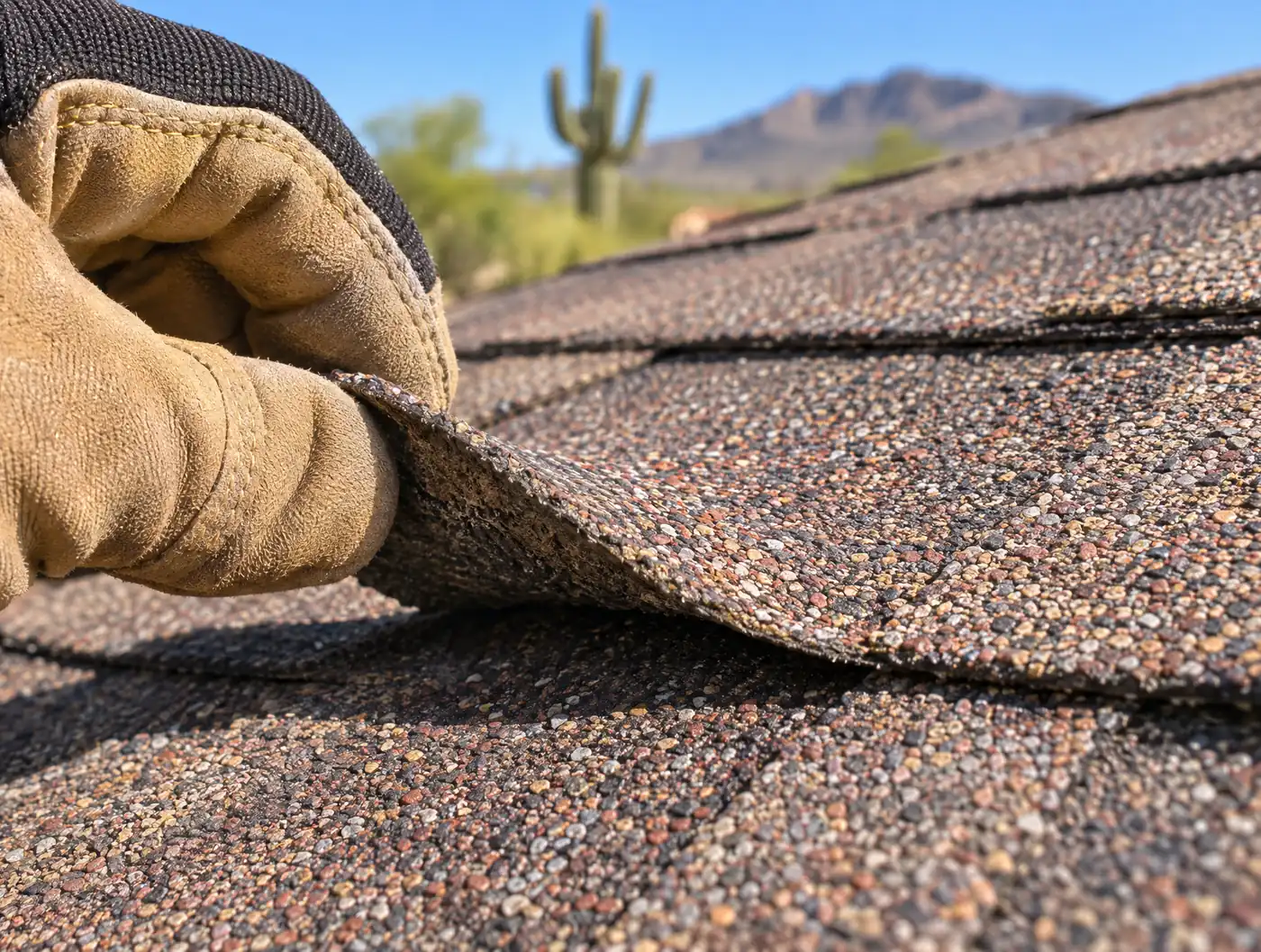
Most people think about their roof when it leaks. A drying shingle roof usually gives some warning first, and you can see most of it without a ladder.
Grab binoculars, or use the zoom on your phone. Walk all the way around the house, including the side yard nobody goes in. Here’s what to look for, and what each thing tells you.
First, what drying out means
An asphalt shingle stays flexible because of the lighter oils and volatile compounds in its asphalt. Sun and heat drive them off. InterNACHI, the home inspectors’ association, says “Shingles become more brittle as volatiles, which keep them flexible, dissipate,” and that losing them “can degrade the bond between the asphalt and the granules” (InterNACHI). Research from Lawrence Berkeley National Laboratory adds that with oxidation, asphalt “becomes harder and embrittled” (LBNL).
Phoenix gives that process plenty of time. On 1991 to 2020 normals, Sky Harbor averages 111 days a year at 100°F or above (NWS Phoenix). So a dry roof here isn’t a sign anyone did something wrong. It’s what desert sun does to asphalt.
Six signs you can check from the ground
1. Granules at the downspouts or along the drip line
Look at the ground under each downspout and along the line where water drips off the roof edge. Dark, sandy grit is granules. Some grit on an older roof is expected. A lot, or more each time you look, means the bond holding them is letting go. That matters because granules shade the asphalt. The LBNL researchers write that it is “essential that the roofing granules absorb the UV component of sunlight.” More on this in why there are granules in your yard.
2. Faded or chalky color
A roof that has gone pale and flat-looking has had a lot of sun. Fading by itself isn’t a problem you need to fix. It tells you the surface has been working hard. Compare the slopes. InterNACHI notes that south-facing slopes age faster, from more thermal cycling and UV, so a big difference between sides is worth noting.
3. Shiny or dark bare spots
Patches that look darker, smoother or shinier than the rest can be places where the granules have worn away and the asphalt shows. Bare asphalt takes the sun with nothing over it. If you can see the mat underneath, the roof is past what a treatment can help. SoyLei, which makes the treatment we use, says its product “Will not fix severe aggregate loss or exposed fiberglass mat” (SoyLei guidance).
Signs that point to brittle shingles
4. Curled or cupped edges
Tabs with edges that turn up, or middles that dip like a shallow cup, are changing shape as they age. You’ll see it best from the street at a low angle, early or late in the day when shadows are long. A few curled tabs in one spot is different from whole slopes of them, so note where they are.
5. Cracked tabs
Straight cracks across a tab, or corners snapped off, are what brittle asphalt does. Look in the gutters and the yard for pieces, too. Cracked shingles need a roofer before anything else. SoyLei says its product is “Not suitable for torn, missing, lifted, or cracked shingles.”
6. Lifted tabs after a storm
Monsoon outflow winds can reach 50 mph or more, the NWS says (NWS Phoenix). After a blow, look for tabs sitting up off the row below, a shingle line that looks wavy, or a gap where a shingle used to be. Lifted or missing shingles are a roofer’s job first. Take photos before anyone touches them.
What you can see from the yard, and what you can’t
| Sign | From the ground? | Who should judge it |
|---|---|---|
| Granules at the downspouts | Yes | You |
| Faded color, one slope worse | Yes, with binoculars | You |
| Bare spots and curling | Partly, with a zoom | You, then a closer look |
| Cracked or lifted tabs | Sometimes | Someone on the roof |
| Soft decking, seal strips, flashing | No | Someone on the roof |
| Leaks | Check ceilings and the attic | You, then a roofer |
Please don’t climb up to look. The EPA says standard black asphalt roofs can reach 165 to 185°F at midday in summer (EPA). That’s a national figure, but it gives you the idea. And a brittle tab can crack under a boot. Leave the walking to someone with the right gear.
What the signs add up to
Grit and fading on a roof where the shingles are still flat and whole describe a roof that’s drying out but sound. That’s the roof roof rejuvenation is meant for. Cracks, lifted or missing shingles, bare mat and leaks describe a roof that needs a roofer first, and maybe a new roof.
Plenty of roofs sit somewhere in between, which is why we look before we suggest anything. SoyLei Innovations of Ames, Iowa makes the soy-based treatment we use, and SoyLei calls it a treatment, “not a replacement for repairs” (SoyLei). We hold to that. You can also check our list of what makes a good candidate.
If you spotted a few of these signs, book a free roof evaluation. We’ll check the parts you can’t see from the yard and tell you which kind of roof you’ve got.
Common questions
Can I tell if my roof is drying out without going up there?
Mostly, yes. Granules at the downspouts, fading, shiny bare patches and curled edges all show from the ground with binoculars or a phone zoom. What you can’t judge from the yard is the deck, the seal strips and the flashing. Those need someone on the roof, and in a Phoenix summer that isn’t a job for a homeowner.
Does a faded roof mean it needs replacing?
Not by itself. Fading tells you the roof has had a lot of sun, and every roof in the Valley has. What matters is what’s under the color: whether the shingles are intact and lying flat, whether granules still cover the asphalt, and whether the deck is firm. A faded roof that checks those boxes may be a candidate for rejuvenation rather than replacement.
Which side of the roof shows the signs first?
Often the south-facing side. InterNACHI notes that south-facing slopes have shorter lifespans because of more thermal cycling and UV exposure, and that darker roofs absorb more heat. If one slope looks noticeably worse than the others, it’s usually the one facing the sun, and it’s the first place to look after a storm.